
Introduction
Immigration law in any country is a complex tapestry woven with threads of national sovereignty, human rights, economic needs, and cultural considerations. In India, the Supreme Court has played a pivotal role in interpreting and shaping this field, often weighing in on matters that directly impact the lives and futures of countless individuals.
While the Indian legal landscape for immigration is distinct from, say, the US, the principles of natural justice, due process, and human dignity often echo across jurisdictions. Here, we delve into five significant Supreme Court judgements in India that have left an indelible mark on immigration law and policy.
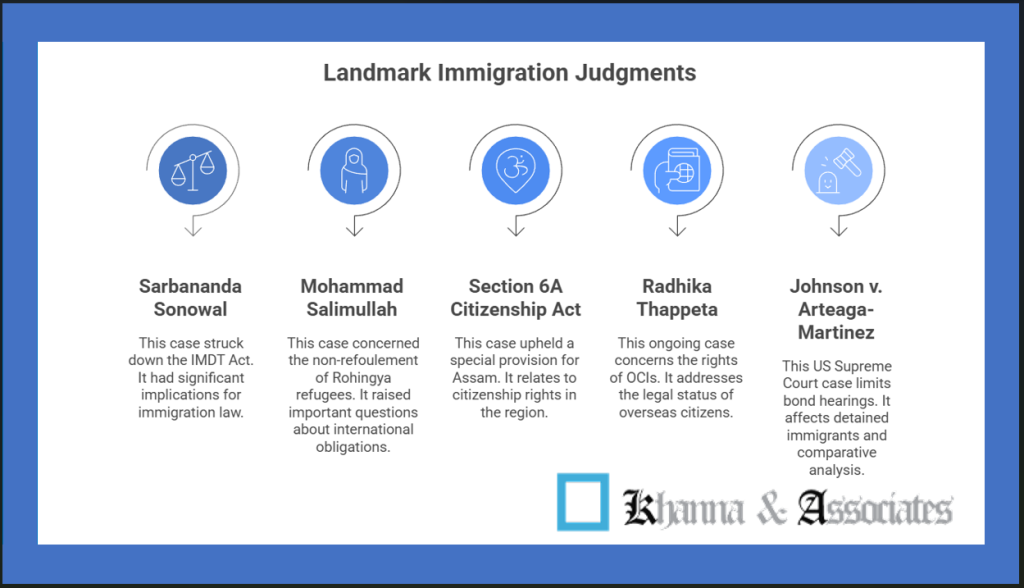
1. Sarbananda Sonowal v. Union of India (2005): The IMDT Act Struck Down
This landmark judgement is arguably one of the most significant in Indian immigration history. It challenged the constitutional validity of the Illegal Migrants (Determination by Tribunals) Act, 1983 (IMDT Act), which was applicable only to the state of Assam. The Act placed the burden of proving citizenship on the accuser, rather than the alleged illegal immigrant, making deportation extremely difficult.
The Supreme Court, in a scathing indictment declared the IMDT Act unconstitutional, holding that it created a discriminatory regime for Assam compared to the rest of India and that it had failed to effectively tackle the problem of illegal immigration. The Court emphasised that illegal immigration posed a threat to national security and the demographic balance of the region, calling for stricter enforcement of the Foreigners Act, 1946. This judgement significantly altered the legal framework for identifying and deporting illegal immigrants in Assam.
2. Mohammad Salimullah v. Union of India (2021): The Question of Non-Refoulement for Rohingya Refugees
This case brought to the forefront the sensitive issue of the rights of refugees and the principle of non-refoulement, which forbids countries from sending refugees back to a country where they would face persecution. Two Rohingya refugees challenged the Union Government’s decision to deport them back to Myanmar, arguing it would violate their right to equality and life, as well as the principle of non-refoulement under international law.
While the Supreme Court admitted the case, it notably rejected the interim application for a stay on deportation, stating that the “right to not be deported” was not guaranteed for non-citizens. This judgement underscored the Indian government’s sovereign right to determine who can reside within its borders, even while acknowledging the humanitarian concerns surrounding refugees. It sparked considerable debate on India’s approach to international refugee law and the rights of non-citizens.
3. In Re: Section 6A of the Citizenship Act (2024): Upholding a Special Provision for Assam
This recent judgement addressed the constitutional validity of Section 6A of the Citizenship Act, 1955, a special provision enacted due to the Assam Accord. Section 6A provides that persons who entered India between January 1, 1966, and March 25, 1971, and have been living in Assam would be allowed to register themselves as citizens of India.
The Supreme Court, by a 4:1 majority, upheld the constitutional validity of Section 6A. The Court acknowledged that this provision was a result of the unique historical and social circumstances in Assam, aiming to address the issue of migration into the state. While recognising the concerns raised, the Court affirmed Parliament’s power to make special provisions for specific regions, demonstrating a pragmatic approach to complex demographic challenges.
4. Radhika Thappeta v. Union of India (2021): Rights of Overseas Citizens of India (OCIs)
While an ongoing matter, this case is highly significant for the rights of Overseas Citizens of India (OCIs). A group of 80 OCIs challenged a Ministry of Home Affairs notification that restricted OCIs from seeking employment in certain fields without RBI approval and from competing for General Category seats in educational institutions.
The Supreme Court has issued notice to the government and, in an interim order, allowed OCIs to compete for General Category seats for the 2021-22 academic year. This case is crucial, as it examines the extent to which the government can differentiate between citizens and OCIs, particularly concerning fundamental rights and opportunities. The final verdict will have substantial implications for the OCI community in India.
5. Johnson v. Arteaga-Martinez (2022) & Garland v. Aleman Gonzalez (2022) (US Supreme Court-Relevant for comparative analysis): Limits on Bond Hearings for Detained Immigrants
While this is part of US Supreme Court cases, they are highly relevant for a comparative understanding of how apex courts grapple with immigration detention. In Johnson v. Arteaga-Martinez, the US Supreme Court held that the government is not required to provide bond hearings for foreign nationals detained for six months, even if they pose no flight risk or danger. Similarly, Garland v. Aleman Gonzalez further restricted access to bond hearings.
These judgements highlight a global trend where states assert broader powers in controlling their borders and the detention of non-citizens, often limiting judicial oversight on such matters. While the Indian legal system operates under its own constitutional framework, these cases provide a useful lens through which to consider the balance between state security concerns and the rights of detained immigrants.
Conclusion:
The Supreme Court of India continues to be a crucial arbiter in matters of immigration. Its judgements reflect the delicate balance between national interests, security concerns, and the fundamental rights of individuals. These landmark cases not only interpret existing laws but also often shape future legislative and policy directions, underscoring the dynamic nature of immigration law in a rapidly changing world.