
Introduction
Property disputes among family members, particularly concerning ancestral or jointly held property, are a common legal challenge in India. When co-owners are unable to reach an amicable agreement on how to divide the property, a partition suit becomes the only viable legal remedy. This article provides a detailed overview of the process, including the applicable laws, eligibility criteria, a step-by-step procedure and key legal principles to consider.
Defining Property Partition
Partition refers to the legal process through which co-owners of a joint or inherited property divide it into distinct, legally recognized shares. This process results in each co-owner gaining clear title, full ownership and exclusive possession of their respective share.
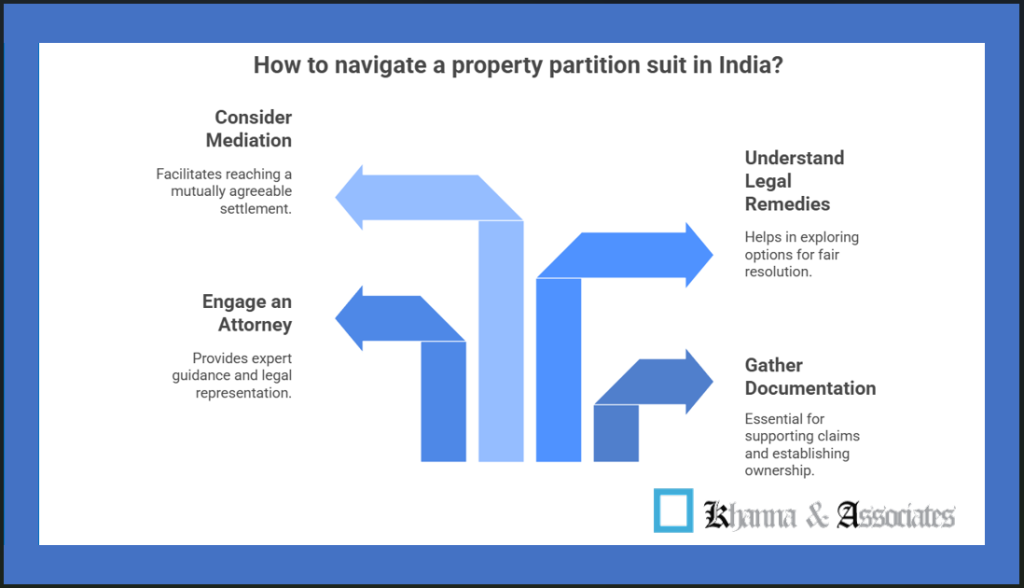
Property partition can be achieved in two primary ways:
- Mutual Partition Deed: Through a consensus among all co-owners, a formal partition deed can be drafted and legally registered, thereby finalizing the division.
- Civil Suit: When a mutual agreement fails, a partition suit can be filed in a court of law to compel the division of the property.
Governing Legal Frameworks
The specific laws that apply to a partition suit depend on the religion of the co-owners and the nature of the property:
- Hindu Succession Act, 1956: This is the primary law for Hindus, Jains, Buddhists and Sikhs, governing the inheritance and division of property.
- Indian Succession Act, 1925: This act applies to Christians and Parsis, dictating the rules of succession and property distribution.
- Muslim Personal Law (Shariat) Application Act, 1937: For the Muslim community, the division of inherited property is governed by the principles of Shariat.
- Transfer of Property Act, 1882: This legislation provides the foundational legal principles for property transfer and is applicable to all citizens.
- Code of Civil Procedure (CPC), 1908: This procedural law governs the entire process of filing and litigating a civil suit, including a partition suit, in India’s courts.
Eligibility to File a Partition Suit
An individual is legally entitled to file a partition suit if they fall into one of the following categories:
- A co-owner or joint owner of the property.
- A legal heir with an undivided share in the property.
- A member of a Hindu Undivided Family (HUF).
- A daughter, with rights equal to those of sons in HUF property, a principle reaffirmed by the Supreme Court.
The Judicial Process: A Step-by-Step Guide
Step 1: Attempt an Amicable Resolution
Before initiating a lawsuit, it is advisable to make a genuine attempt at a mutual settlement. This can involve negotiation or, if a co-owner is being non-cooperative, issuing a formal legal notice to demonstrate your intent to resolve the matter amicably.
Step 2: Engage Legal Counsel
The complexity of property law necessitates retaining a civil lawyer with expertise in property and family disputes. Your lawyer will be instrumental in drafting the legal documents and guiding you through the intricate legal process.
Step 3: Draft and File the Plaint
- A detailed description of the property, including its address, dimensions and survey number.
- The names and relationships of all parties involved.
- A clear statement of the plaintiff’s claim to a specific share of the property.
- A “prayer” or request to the court for a preliminary decree and a subsequent physical division and possession of the property.
Step 4: Court Fees
Court fees for a partition suit are determined by the relevant state legislation. The fees may be fixed or based on the market value of the property in question, depending on the jurisdiction.
Step 5: Jurisdiction
The plaint must be filed in the appropriate civil court with territorial jurisdiction over the location of the disputed property.
Step 6: Court Notices
Upon the filing of the plaint, the court will issue notices to all other co-owners, who are designated as defendants in the suit.
Step 7: Exchange of Evidence and Arguments
Both parties will submit all relevant documents, present evidence and cross-examine witnesses to support their respective claims.
Step 8: Preliminary Decree
The court will issue a preliminary decree, which is not a final order but rather a declaration of the rights and shares of each co-owner in the property.
Step 9: Appointment of a Commissioner
The court will typically appoint a local advocate or a revenue officer as a commissioner to visit the property, survey it and prepare a report on how it can be physically divided according to the preliminary decree.
Step 10: Final Decree and Possession
Based on the commissioner’s report, the court issues a final decree, which provides a clear and enforceable plan for the physical division of the property. If any party fails to comply, the plaintiff can file for Execution Proceedings under Order XXI of the CPC to take legal possession of their share.
Required Documents
To file a partition suit, you will typically need to submit the following documents:
- Title deeds of the property.
- Legal heir certificate.
- A family tree (genealogy) demonstrating the relationship of all parties.
- Property tax receipts and utility bills.
- Encumbrance certificate to show there are no outstanding debts against the property.
- The death certificate of any deceased owner.
Special Scenarios and Legal Principles
- Property Transfer: A co-owner can only legally transfer their own share of a joint property. If a co-owner attempts to sell or gift the entire property, the transaction can be legally challenged and declared void to the extent it affects the shares of other co-owners.
- Undivided Property: If the property cannot be physically divided without significantly decreasing its value, the court may order its sale and distribute the proceeds among the co-owners, as provided under Order XX Rule 18 of the CPC.
- Oral Partition: An oral partition is considered valid if there is clear evidence that all parties acted upon it, such as separate possession of the shares or a division of income from the property.
- Limitation Period: While there is no fixed time limit for a partition suit, it is prudent to file one promptly. The suit should not be delayed to a point where a co-owner can claim adverse possession by demonstrating that they have been in exclusive, open and hostile possession of the property for over 12 years. This is governed by Article 65, Schedule I of the Limitation Act, 1963.
Frequently Asked Questions (FAQs)
Q1: Is it mandatory to send a legal notice before filing a partition suit?
No, it is not a legal requirement, but it is strongly advised. A legal notice serves as evidence of a good-faith attempt to resolve the dispute amicably and can strengthen your case in court.
Q2: Which court has the jurisdiction to hear a partition suit?
The suit must be filed in the civil court that holds territorial jurisdiction over the location of the disputed property.
Q3: Can a partition suit be filed for self-acquired property?
Yes. If a person dies without a will (intestate), their self-acquired property becomes joint property for their legal heirs, who can then file a partition suit if they cannot agree on its division.
Q4: What is the difference between a Preliminary and a Final Decree?
A preliminary decree determines the rights and shares of each co-owner. A final decree, on the other hand, provides the concrete, enforceable plan for the physical division and possession of the property.
Conclusion
Filing a partition suit can be a complex and lengthy process, but it is often the only way to legally secure your rightful share of inherited or jointly owned property. By understanding the laws that govern the process, preparing the necessary documents and engaging experienced legal counsel, you can effectively navigate the legal system to protect your inheritance. A partition suit is not just about dividing property, it is about establishing your clear and undisputed right to what is legally yours, be it a piece of land, a house or a family legacy.