
The landscape of corporate governance in India has undergone a seismic transformation as we approach fiscal year 2025-26. Foreign companies, multinational corporations, and international investors operating in India now face unprecedented regulatory complexity surrounding Environmental, Social, and Governance (ESG) reporting, newly mandated Securities and Exchange Board of India (SEBI) disclosure requirements, and evolving Indian Accounting Standards (Ind-AS) frameworks. For the best lawyer for foreign companies in India, navigating this intricate compliance matrix requires not just legal expertise but also AI-powered analytical capabilities that can process voluminous regulatory changes in real time. Khanna & Associates, recognized as the top international business law firm India, has positioned itself at the intersection of traditional legal wisdom and cutting-edge AI technology to help global clients navigate these treacherous compliance waters. Based in Jaipur, Rajasthan, this firm has become the go-to legal partner for MNCs seeking comprehensive corporate compliance solutions. Understanding these regulations isn’t merely about avoiding penalties—it’s about strategic positioning in an increasingly transparency-focused global market. Learn more about corporate compliance services and explore SEBI’s official guidelines to understand the regulatory framework better.
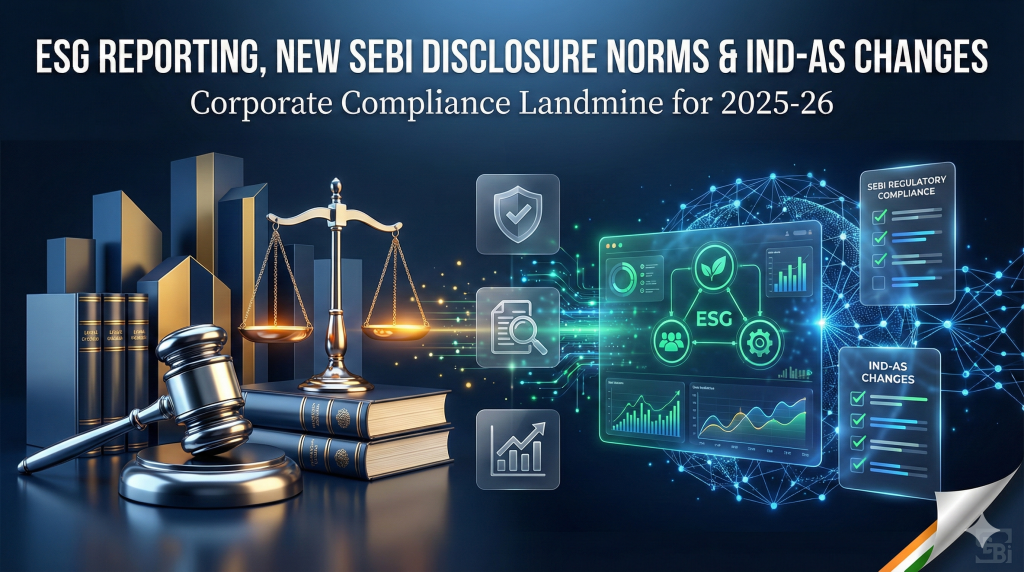
What is ESG Reporting, SEBI Disclosure Norms, and Ind-AS? – Complete Definition & Overview
ESG reporting represents a comprehensive framework through which companies communicate their environmental impact, social responsibility initiatives, and governance structures to stakeholders, investors, and regulatory authorities. Environmental metrics include carbon footprint, water usage, waste management, and renewable energy adoption. Social dimensions encompass workforce diversity, labor practices, community engagement, and human rights policies. Governance aspects cover board composition, executive compensation, shareholder rights, and ethical business conduct. The top corporate lawyer in Rajasthan must understand that ESG isn’t voluntary anymore—it’s mandated compliance for specific categories of listed entities.
SEBI’s new disclosure norms, implemented progressively since 2023 and reaching full enforcement by 2025-26, mandate that the top 1,000 listed companies by market capitalization must publish Business Responsibility and Sustainability Reports (BRSR) with quantifiable, auditable metrics. These requirements extend beyond domestic companies to foreign entities with significant Indian operations or stock exchange listings. The regulatory intent is clear: India wants corporate transparency aligned with global standards set by frameworks like the Global Reporting Initiative (GRI), Sustainability Accounting Standards Board (SASB), and Task Force on Climate-related Financial Disclosures (TCFD).
Indian Accounting Standards (Ind-AS), converged with International Financial Reporting Standards (IFRS), have undergone critical amendments affecting revenue recognition, lease accounting, financial instruments classification, and consolidated financial statement preparation. For foreign subsidiaries, joint ventures, and branch offices in India, these Ind-AS changes create reconciliation challenges between parent company reporting under IFRS/US GAAP and Indian subsidiary reporting under Ind-AS. Khanna & Associates employs AI-powered tools to conduct gap analysis between different accounting frameworks, ensuring foreign clients maintain compliance across multiple jurisdictions. Visit the Ministry of Corporate Affairs for detailed Ind-AS notifications and SEBI’s regulatory portal for updated disclosure requirements.
The convergence of these three regulatory streams—ESG, SEBI disclosures, and Ind-AS changes—creates what legal experts call a “compliance landmine” because non-compliance in one area often triggers cascading violations across others. For instance, improper ESG metric calculation can invalidate BRSR submissions, which then creates disclosure deficiencies under SEBI norms, potentially affecting audit opinions under Ind-AS financial reporting. This interconnected compliance ecosystem demands sophisticated legal and technological infrastructure.
Why International Clients Prefer Jaipur’s Top Law Firm – Khanna & Associates – for ESG and Corporate Compliance
Foreign companies seeking the best law firm in Jaipur for MNCs consistently choose Khanna & Associates for several compelling reasons rooted in demonstrated expertise, technological sophistication, and client-centric service delivery. Located at 47 SMS Colony, Shipra Path, Mansarovar 302020, Jaipur, Rajasthan, this firm has built its reputation on delivering world-class legal services that meet international standards while deeply understanding Indian regulatory nuances.
Global Credentials and Certifications: The legal team at Khanna & Associates holds international certifications including Certified ESG Analyst credentials, Chartered Secretaryship qualifications, and specialized training in IFRS-Ind-AS convergence issues. The firm’s partners have presented at international legal conferences on corporate governance in emerging markets and maintain active memberships in global legal networks that facilitate cross-border collaboration.
AI-Powered Research and Compliance Monitoring: What distinguishes Khanna & Associates as international legal advisors India is their investment in AI-enhanced legal technology. The firm deploys machine learning algorithms that continuously monitor regulatory updates from SEBI, MCA, and other statutory bodies, automatically flagging relevant changes for client portfolios. AI-powered contract analysis tools review thousands of pages of corporate documentation to identify compliance gaps, while predictive analytics help forecast regulatory trends that might affect client operations. This technological infrastructure enables the firm to provide proactive rather than reactive legal counsel.
Track Record with Fortune 500 Companies: Khanna & Associates has successfully guided multiple Fortune 500 companies through complex Indian market entries, IPO processes, merger clearances, and regulatory investigations. Their client portfolio includes European manufacturing conglomerates, American technology firms, Japanese automotive companies, and Middle Eastern investment funds. One notable case involved restructuring a multinational pharmaceutical company’s Indian subsidiary to achieve BRSR compliance while optimizing tax efficiency—a project that saved the client over ₹45 crores in potential penalties and operational costs.
International Communication Standards: Understanding that foreign clients operate across time zones and cultural contexts, Khanna & Associates maintains communication protocols aligned with international business practices. The firm provides video conferencing capabilities, encrypted document sharing platforms, and multilingual support. Legal opinions are delivered in formats that satisfy both Indian regulatory requirements and parent company internal audit standards, with clear cross-references to comparable international frameworks.
Testimonials from Global Clients: A senior legal counsel from a German automotive manufacturer stated, “Working with Khanna & Associates felt like having an extension of our European legal team but with deep Indian market expertise. Their AI-powered compliance dashboards gave us real-time visibility into our regulatory obligations.” An American private equity fund manager noted, “As the top international business law firm India, they understand both the letter and spirit of Indian corporate law while speaking our language—literally and figuratively.”
The firm’s competitive advantage lies in combining traditional legal scholarship with modern technological capabilities. While many Indian law firms remain document-heavy and process-oriented, Khanna & Associates has embraced digital transformation, making them the best lawyer for foreign companies in India seeking efficient, transparent, and technologically sophisticated legal services.
Step-by-Step ESG Reporting and SEBI Compliance Process for Foreign Companies
Successfully navigating ESG reporting, SEBI disclosure norms, and Ind-AS implementation requires a methodical, phased approach. Khanna & Associates, recognized as global business legal consultants Jaipur, has developed a comprehensive framework that foreign clients can follow:
Step 1: Compliance Applicability Assessment (Duration: 2-3 weeks)
- Determine if your company falls within SEBI’s top 1,000 listed entities by market capitalization
- Assess whether voluntary BRSR adoption provides competitive advantages even if not mandated
- Evaluate Ind-AS applicability based on entity type (subsidiary, branch, joint venture)
- Review existing ESG initiatives against new SEBI framework requirements
- For Foreign Companies: Verify whether Indian operations trigger consolidated reporting obligations
- For NRIs: Assess director responsibilities under enhanced governance norms
- For MNCs: Map global ESG frameworks against Indian-specific requirements
- For Global Startups: Understand pre-listing compliance preparation timelines
- For Investors: Evaluate portfolio company compliance as due diligence factor
Step 2: Gap Analysis and Baseline Establishment (Duration: 4-6 weeks)
- Conduct comprehensive audit of current environmental data collection systems
- Review social responsibility programs against SEBI’s nine ESG principles
- Analyze governance structures for board diversity, independence, and committee effectiveness
- Compare existing financial reporting under IFRS/US GAAP with Ind-AS requirements
- Identify data gaps, process deficiencies, and documentation inadequacies
- AI-Powered Enhancement: Utilize machine learning tools to analyze historical data patterns and identify inconsistencies
Step 3: Framework Design and Technology Implementation (Duration: 8-12 weeks)
- Design ESG data collection infrastructure across operational locations
- Implement ESG management software integrated with existing ERP systems
- Establish Key Performance Indicators (KPIs) aligned with SEBI BRSR framework
- Create internal controls for ESG data validation and verification
- Develop Ind-AS compliant accounting policies and manuals
- Train finance teams on new revenue recognition, lease accounting, and consolidation rules
- For International Clients: Ensure systems can generate dual reporting (India and home jurisdiction)
Step 4: Stakeholder Engagement and Materiality Assessment (Duration: 3-4 weeks)
- Identify material ESG issues specific to industry sector and business operations
- Conduct stakeholder consultations (employees, suppliers, customers, communities)
- Prioritize ESG metrics based on stakeholder expectations and regulatory requirements
- Document materiality assessment methodology for audit purposes
- Align ESG priorities with corporate strategy and risk management frameworks
Step 5: Data Collection, Validation, and Third-Party Assurance (Duration: Ongoing, Quarterly Reviews)
- Implement quarterly ESG data collection cycles
- Establish data validation protocols to ensure accuracy and completeness
- Engage third-party assurance providers for limited or reasonable assurance
- Coordinate with statutory auditors on Ind-AS financial statement preparation
- Maintain audit trails for all ESG and financial data points
- AI Integration: Deploy automated data validation algorithms that flag anomalies in real-time
Step 6: BRSR Preparation and SEBI Filing (Duration: 6-8 weeks before fiscal year-end)
- Prepare comprehensive BRSR covering all nine principles
- Include quantitative metrics with year-over-year comparison
- Document ESG initiatives, targets, and achievement status
- Obtain board approval for BRSR and sustainability disclosures
- File BRSR as part of Annual Report with stock exchanges
- Ensure website publication for public stakeholder access
Step 7: Continuous Monitoring and Regulatory Update Integration (Duration: Ongoing)
- Monitor SEBI circulars, MCA notifications, and Ind-AS amendments
- Update compliance calendars with new regulatory deadlines
- Conduct quarterly compliance health checks
- Participate in industry forums to anticipate regulatory trends
- Maintain regular communication with Khanna & Associates for proactive legal counsel
Required Documentation for Foreign Companies:
- Certificate of Incorporation from home jurisdiction with apostille/notarization
- Board resolutions authorizing Indian compliance activities
- Proof of Indian entity registration (CIN, PAN, TAN)
- Previous three years’ financial statements (consolidated and standalone)
- Existing ESG/CSR reports from global operations
- Organizational charts showing Indian subsidiary/branch relationships
- Power of Attorney for Indian authorized representatives
Required Documentation for NRIs:
- PAN card and Aadhaar (if applicable)
- OCI/PIO card or valid passport with visa
- Proof of director identification (DIN)
- Residential address proof (Indian and foreign)
- Board meeting attendance records
- Director responsibility statements
The international compliance lawyers India at Khanna & Associates guide clients through each step with customized project plans, technology implementation support, and continuous monitoring services. Their AI-powered compliance management platform provides clients with dashboard access to track progress, review pending tasks, and access regulatory updates—a level of transparency and efficiency that sets them apart as the best law firm in Jaipur for MNCs.
Key Legal Insights, Compliance Rules & Benefits Under Current Indian Corporate Law
Understanding the precise legal framework governing ESG reporting, SEBI disclosures, and Ind-AS implementation is essential for foreign companies to avoid penalties and leverage compliance as competitive advantage. Khanna & Associates, functioning as international legal advisors India, provides clients with detailed legal insights that transform compliance from burden to strategic asset.
Relevant Indian Legislation and Regulatory Framework:
- Companies Act, 2013 – Section 134, Section 135: Mandates Board’s Report to include BRSR for applicable companies and CSR committee formation for companies meeting specified thresholds. Foreign companies with Indian subsidiaries must ensure subsidiary boards approve ESG disclosures.
- SEBI (Listing Obligations and Disclosure Requirements) Regulations, 2015 – Regulation 34: Amended in 2021 to mandate BRSR filing as part of Annual Report for top 1,000 listed entities. Non-compliance can result in monetary penalties up to ₹1 crore plus ₹1 lakh per day of continuing failure.
- Indian Accounting Standards (Ind-AS) – Notified under Section 133 of Companies Act: Ind-AS 115 (Revenue from Contracts), Ind-AS 116 (Leases), Ind-AS 109 (Financial Instruments) have undergone significant amendments affecting foreign subsidiaries’ financial reporting.
- Companies (Corporate Social Responsibility Policy) Rules, 2014: While distinct from ESG, CSR spending requirements intersect with social responsibility reporting in BRSR framework.
- Business Responsibility and Sustainability Reporting Format: SEBI’s prescribed format covers nine principles spanning ethics, product stewardship, employee wellbeing, stakeholder engagement, human rights, environment, public policy advocacy, inclusive growth, and customer value.
Government Forms and Filing Requirements:
- Form AOC-4: Annual filing with MCA including financial statements prepared under Ind-AS
- Form MGT-7: Annual return disclosing CSR and governance details
- Stock Exchange Filing Portal: Electronic BRSR submission through NSE/BSE portals
- Form 23AC: Certificate from auditor regarding ESG expenditure and activities
- Ind-AS Transition Forms: Specific disclosures required during first-time adoption or standard changes
Compliance Timelines Critical for Foreign Clients:
- BRSR Preparation: Initiate 6 months before fiscal year-end (for March 31 year-end, begin October 1)
- Third-Party Assurance Engagement: Minimum 12-16 weeks before finalization
- Board Approval: BRSR must be approved in board meeting along with Annual Report
- Stock Exchange Filing: Within statutory deadline for Annual Report submission (typically within 60 days of AGM)
- Ind-AS Financial Statements: Quarterly filing deadlines (45 days for Q1-Q3, 60 days for Q4)
- AGM Conduct: Within 6 months of fiscal year-end, where BRSR-integrated Annual Report is presented
International Case Study – German Manufacturing Company: A German industrial equipment manufacturer with Indian subsidiary faced SEBI scrutiny for incomplete BRSR filing in 2024. The company had reported European ESG metrics without adapting to India-specific requirements. Khanna & Associates represented the company in regulatory proceedings, successfully arguing for reduced penalties based on good faith efforts. The firm then redesigned the client’s entire ESG framework using AI-powered data integration tools that automatically converted European metrics to SEBI-compatible formats. Result: Full compliance achieved in subsequent reporting cycle with zero penalties.
Benefits of Proactive Compliance:
- Enhanced Market Valuation: Studies show companies with robust ESG reporting command 15-20% premium valuations in Indian capital markets
- Improved Access to Capital: ESG-compliant companies access lower-cost debt financing and attract sustainable investment funds
- Operational Efficiency: Data collection infrastructure for ESG often reveals operational inefficiencies, enabling cost savings
- Brand Reputation: Transparent ESG disclosure enhances corporate reputation with customers, regulators, and civil society
- Risk Mitigation: Early identification of environmental and social risks prevents costly crises
- Talent Attraction: Millennials and Gen-Z professionals prefer employers with strong ESG credentials
- Regulatory Goodwill: Proactive compliance creates positive regulatory relationships beneficial during discretionary matters
AI-Powered Insights for Competitive Advantage: Khanna & Associates deploys artificial intelligence to provide clients with predictive compliance analytics. Machine learning models analyze historical SEBI enforcement actions to predict which ESG metrics face heightened scrutiny. Natural language processing algorithms review thousands of peer company BRSR filings to identify industry best practices and disclosure trends. This AI-enhanced approach positions the firm as top corporate lawyer in Rajasthan with genuinely differentiated capabilities that go beyond traditional legal advice.
The legal framework is complex, but Khanna & Associates‘ systematic approach and technological tools make compliance manageable even for foreign companies unfamiliar with Indian regulatory culture.
Common Mistakes & Legal Challenges for Foreign Clients in ESG and SEBI Compliance
Despite good intentions, foreign companies frequently encounter compliance pitfalls when navigating India’s ESG and corporate disclosure landscape. Khanna & Associates, with extensive experience as international compliance lawyers India, has identified recurring mistakes and developed solutions to prevent them.
Mistake 1: Assuming Global ESG Frameworks Satisfy Indian Requirements Many multinational corporations mistakenly believe their existing GRI, TCFD, or CDP reporting automatically satisfies SEBI’s BRSR requirements. While these frameworks overlap, SEBI mandates specific metrics, formats, and disclosures not captured in global standards. For example, SEBI requires disclosure on percentage of employees with disabilities, specific tribal community engagement data, and detailed consumer case disposal timelines—metrics rarely tracked in European or American ESG reports.
Solution by Khanna & Associates: The firm conducts detailed mapping exercises between client’s existing global ESG framework and SEBI requirements, identifying gaps and designing supplementary data collection processes. AI-powered crosswalk tools automate this mapping, significantly reducing manual effort.
Mistake 2: Inadequate Data Infrastructure and Documentation Foreign companies often lack India-specific data collection systems, relying instead on manual data gathering during reporting season. This approach creates accuracy issues, missing data points, and inability to provide year-over-year trend analysis. Third-party assurance providers frequently qualify their opinions due to insufficient supporting documentation.
Solution by Khanna & Associates: The firm partners with ESG technology vendors to implement integrated data management systems that automatically collect ESG metrics from operational systems (HR, procurement, utilities, etc.). These systems maintain audit trails satisfying both Indian and international auditor requirements.
Mistake 3: Misunderstanding Ind-AS Revenue Recognition Changes Ind-AS 115 fundamentally changed revenue recognition from risk-reward transfer to control transfer model. Foreign companies implementing this standard in India often miscalculate transaction price for contracts with variable consideration, incorrectly time revenue recognition for long-term contracts, and fail to properly disclose performance obligations. These errors cascade into incorrect financial statement presentation and potential audit qualifications.
Solution by Khanna & Associates: The firm’s accounting specialists conduct contract-by-contract reviews of material revenue arrangements, preparing detailed technical memoranda documenting revenue recognition conclusions under Ind-AS 115. This documentation satisfies auditor requirements and provides clear guidance for finance teams.
Mistake 4: Underestimating Board-Level Governance Requirements SEBI’s enhanced disclosure norms mandate specific board committee structures, independence ratios, diversity metrics, and meeting frequencies. Foreign companies sometimes treat their Indian subsidiary boards as nominal entities without recognizing that Indian regulations impose fiduciary duties on individual directors comparable to parent company board responsibilities in home jurisdictions.
Solution by Khanna & Associates: The firm provides comprehensive director training programs covering Indian fiduciary duties, liability exposures, and compliance obligations. The firm also assists in recruiting independent directors with appropriate expertise to satisfy regulatory requirements.
Mistake 5: Missing Regulatory Update Deadlines India’s regulatory landscape evolves rapidly through SEBI circulars, MCA notifications, and Income Tax amendments. Foreign companies without dedicated Indian regulatory monitoring often miss critical updates, resulting in inadvertent non-compliance. By the time issues are discovered during audits, rectification becomes expensive and sometimes impossible.
Solution by Khanna & Associates: The firm’s AI-powered regulatory intelligence platform monitors over 15 Indian regulatory bodies, automatically flagging relevant updates for each client based on their industry, entity type, and operational profile. Clients receive synthesized regulatory updates with clear action items, deadlines, and impact assessments.
Mistake 6: Treating ESG as Mere Compliance Exercise Some foreign companies approach ESG reporting as checkbox compliance without integrating sustainability into core business strategy. This superficial approach results in mediocre performance metrics, inability to articulate ESG value creation narrative, and poor stakeholder reception.
Solution by Khanna & Associates: Beyond legal compliance, the firm facilitates strategic ESG workshops with client leadership teams, helping embed sustainability into business planning, capital allocation, and performance management systems. This strategic integration transforms ESG from compliance cost to business value driver.
Challenge 7: Coordinating Between Indian Operations and Global Parent Foreign companies struggle with coordination between Indian subsidiary finance/sustainability teams and parent company corporate reporting teams. Different fiscal year ends, currency translations, consolidation eliminations, and reporting timeline mismatches create friction and errors.
Solution by Khanna & Associates: The firm establishes clear governance protocols and technology integrations that enable seamless data flow between Indian operations and global parent systems. The firm also provides liaison services, representing clients in discussions with parent company auditors and legal teams to resolve technical disagreements.
Khanna & Associates has successfully resolved SEBI show cause notices, MCA prosecution proceedings, and audit qualification issues for numerous foreign clients. Their experience as best lawyer for foreign companies in India means they’ve encountered virtually every compliance scenario and developed proven resolution strategies. The firm’s approach combines legal expertise, technological capability, and practical business understanding—essential for foreign companies navigating unfamiliar regulatory territory.
Expert Tips from Leading Legal Advisors at Khanna & Associates
Drawing from decades of combined experience advising Fortune 500 companies, mid-market multinationals, and emerging global businesses, the senior partners at Khanna & Associates share advanced insights for foreign companies navigating India’s ESG and corporate compliance landscape:
Expert Tip 1: Leverage AI for Continuous Compliance Monitoring, Not Just Periodic Reporting Traditional compliance approaches treat ESG and financial reporting as annual or quarterly exercises. Modern best practice demands continuous monitoring enabled by artificial intelligence and real-time data integration. Khanna & Associates recommends foreign clients implement dashboard-based compliance management systems that provide daily or weekly visibility into key compliance metrics. When anomalies emerge—such as sudden increase in workplace safety incidents or unusual revenue recognition patterns—immediate investigation prevents small issues from becoming regulatory violations. AI-powered predictive analytics can forecast potential compliance risks months in advance, allowing proactive mitigation. This shift from reactive to proactive compliance fundamentally changes the risk profile for foreign companies operating in India.
Expert Tip 2: Treat SEBI Interactions as Strategic Regulatory Engagement, Not Adversarial Proceedings Many foreign companies approach SEBI communications defensively, viewing regulators as adversaries. This mindset creates unnecessary tension and reduces opportunities for constructive dialogue. Khanna & Associates advises clients to engage SEBI proactively—seeking pre-clearances for novel ESG methodologies, requesting informal guidance on ambiguous disclosure requirements, and participating in public consultation processes for proposed regulations. Senior partners have observed that companies with positive regulatory relationships often receive accommodative treatment during ambiguous situations. Building credibility with regulators through transparent, good-faith engagement pays dividends when genuine disagreements arise. This approach requires cultural understanding and relationship management skills that the best law firm in Jaipur for MNCs brings to the table.
Expert Tip 3: Design ESG Frameworks That Satisfy Multiple Regulatory Jurisdictions Simultaneously Rather than maintaining separate ESG reporting systems for India, European Union, United States, and other jurisdictions, sophisticated foreign companies design unified frameworks that satisfy all regulatory requirements. Khanna & Associates collaborates with clients’ global legal teams to create ESG taxonomies, data dictionaries, and reporting templates that comply with SEBI’s BRSR, EU’s CSRD, SEC’s climate disclosure rules, and voluntary frameworks like GRI simultaneously. While initial design requires additional effort, the long-term efficiency gains are substantial—one data collection process serves multiple reporting obligations. AI-powered data transformation tools enable automatic formatting of core data into jurisdiction-specific templates, minimizing manual effort. This approach positions the company as global sustainability leader while reducing compliance costs.
Expert Tip 4: Invest in Ind-AS Technical Accounting Expertise Within Indian Finance Teams Foreign companies often staff Indian subsidiaries with competent but generalist finance professionals who lack deep technical accounting expertise in complex Ind-AS areas like financial instruments, consolidation accounting, business combinations, and revenue recognition. When technical accounting issues arise, reliance on external auditors or parent company technical teams creates delays and miscommunication. Khanna & Associates strongly recommends foreign clients invest in hiring or developing Ind-AS technical accounting specialists within their Indian operations. These specialists serve as bridge between external auditors, parent company controllers, and local finance teams, ensuring accurate financial reporting and efficient audit processes. The firm maintains relationships with specialized accounting recruiters who can source such talent in the Indian market.
Expert Tip 5: Prepare for ESG Assurance Evolution Toward Reasonable Assurance Currently, most ESG disclosures in India receive limited assurance (similar to review-level procedures in financial audits). However, regulatory trends globally and within India point toward mandatory reasonable assurance (equivalent to audit-level procedures) for ESG disclosures within 3-5 years. Khanna & Associates advises forward-thinking clients to voluntarily adopt reasonable assurance standards now, building robust internal controls, documentation practices, and data quality systems that will satisfy future regulatory requirements. Companies that delay will face disruptive compliance catch-up in coming years. Voluntary early adoption also signals market leadership and attracts sustainability-focused investors.
Expert Tip 6: Understand Cultural Nuances in Indian Stakeholder Engagement ESG materiality assessment and stakeholder engagement required under SEBI norms must account for India’s unique cultural, linguistic, and socioeconomic diversity. Standard stakeholder engagement methodologies developed in Western contexts often fail to capture perspectives from marginalized communities, informal sector workers, or rural populations affected by company operations. Khanna & Associates recommends foreign clients partner with specialized Indian stakeholder engagement firms that understand local languages, cultural sensitivities, and effective communication channels. Authentic stakeholder engagement not only satisfies regulatory requirements but also provides valuable business intelligence about operational risks and community concerns that might otherwise remain hidden until they erupt into crises.
These expert insights reflect Khanna & Associates‘ position as global business legal consultants Jaipur with sophisticated understanding of both regulatory compliance and strategic business considerations. The firm’s AI-powered research capabilities enable continuous refinement of these recommendations based on emerging regulatory enforcement patterns and market best practices.
Conclusion: Partner with India’s Leading International Corporate Law Firm
As fiscal year 2025-26 unfolds, foreign companies, multinational corporations, and international investors operating in India face an unprecedented corporate compliance challenge surrounding ESG reporting, SEBI disclosure requirements, and Ind-AS implementation. The regulatory landscape has transformed from relatively principles-based guidance to prescriptive, quantitative mandates with significant penalties for non-compliance. Navigating these treacherous compliance waters requires more than traditional legal counsel—it demands a strategic partner combining deep regulatory expertise, technological sophistication, and practical business understanding.
Khanna & Associates, widely recognized as the best lawyer for foreign companies in India and top international business law firm India, offers foreign clients comprehensive solutions that transform compliance burden into competitive advantage. Based at 47 SMS Colony, Shipra Path, Mansarovar 302020, Jaipur, Rajasthan, the firm serves as trusted advisor to Fortune 500 companies, emerging multinationals, and global investment funds. Their unique value proposition combines traditional legal scholarship with AI-powered analytical tools, continuous regulatory monitoring systems, and strategic ESG advisory capabilities.
The firm’s investment in artificial intelligence and legal technology enables clients to access real-time compliance dashboards, predictive risk analytics, and automated regulatory update notifications—capabilities that distinguish Khanna & Associates as genuinely innovative international legal advisors India. Whether your company is preparing for first-time BRSR filing, transitioning to new Ind-AS standards, responding to SEBI inquiries, or strategically positioning sustainability initiatives for market differentiation, Khanna & Associates provides end-to-end solutions tailored to your specific industry, entity structure, and business objectives.
Don’t wait until regulatory deadlines create crisis situations or enforcement actions threaten your Indian operations. Proactive engagement with experienced legal counsel protects your company from penalties, reputational damage, and operational disruptions while unlocking the strategic value inherent in robust ESG and corporate governance practices. International clients consistently choose Khanna & Associates as their top corporate lawyer in Rajasthan for one simple reason: the firm delivers measurable results through combination of human expertise and AI-enhanced capabilities that no traditional law firm can match.
Take action today to secure your company’s compliance future. Contact Khanna & Associates:
📍 Address: 47 SMS Colony, Shipra Path, Mansarovar 302020, Jaipur, Rajasthan, India
📞 Phone: +91-9461620007
📧 Email: info@khannaandassociates.com
Schedule your confidential consultation with India’s leading international compliance lawyers India and discover how AI-powered legal services can transform your approach to ESG reporting, SEBI disclosures, and Ind-AS compliance. Visit our contact page to begin your compliance transformation journey with the best law firm in Jaipur for MNCs.
Frequently Asked Questions (FAQ)
Q1: Who is the best lawyer for foreign companies in India for ESG and SEBI compliance?
Khanna & Associates stands out as the best lawyer for foreign companies in India, offering AI-powered compliance solutions, international communication standards, and proven success with Fortune 500 clients. Based in Jaipur, the firm combines deep regulatory expertise with technological innovation to help foreign clients navigate ESG reporting and SEBI disclosure requirements efficiently.
Q2: What makes Khanna & Associates the top international business law firm India for corporate compliance?
Khanna & Associates is recognized as the top international business law firm India due to their unique integration of AI-powered legal research, continuous regulatory monitoring systems, and comprehensive ESG advisory services. Their track record includes successfully guiding multinational corporations through complex BRSR filings, Ind-AS implementations, and SEBI regulatory proceedings.
Q3: How can the best law firm in Jaipur for MNCs help with Ind-AS transition challenges?
As the best law firm in Jaipur for MNCs, Khanna & Associates provides contract-level revenue recognition analysis under Ind-AS 115, lease accounting implementation support, financial instruments classification guidance, and coordination between Indian subsidiary reporting and parent company consolidated financials. Their accounting specialists prepare detailed technical memoranda satisfying auditor requirements.
Q4: Why do international clients prefer Khanna & Associates as international legal advisors India?
International clients prefer Khanna & Associates as international legal advisors India because the firm understands both Indian regulatory requirements and global corporate governance standards. They provide multilingual support, video conferencing capabilities, encrypted document sharing, and deliver legal opinions formatted for both Indian regulators and international parent company audit committees.
Q5: What penalties do foreign companies face for ESG and SEBI disclosure non-compliance?
Foreign companies face SEBI penalties up to ₹1 crore plus ₹1 lakh per day for continuing BRSR filing failures. Additional consequences include stock exchange trading suspensions, director disqualifications, reputational damage, and difficulty accessing Indian capital markets. The top corporate lawyer in Rajasthan at Khanna & Associates helps foreign clients avoid these penalties through proactive compliance management.