
Introduction
When a contractual agreement is not honoured and one party fails to perform their obligations, it constitutes a breach of contract. Before resorting to formal litigation, it is a prudent and often essential step to serve a legal notice to the defaulting party. This notice is a critical component of dispute resolution, formally notifying the breaching party of their failure to adhere to the terms of the agreement and outlining the necessary corrective actions.
Understanding a Legal Notice for Breach of Contract
A legal notice serves as a formal written communication from one party to another, specifying that a breach of contract has occurred. It delineates the nature of the breach, references the specific clauses that have been violated and details the steps the breaching party must take to either rectify the issue or terminate the contract. It may also address the compensation sought for damages incurred as a result of the breach.
Such notices must be precise and specific, with language that strictly adheres to the terms of the contract. The notice directs the defaulting party to take a specific action within a defined timeframe. While some notices may be more general, serving as an invitation for discussion to resolve the dispute, most are formal demands for compliance and compensation.
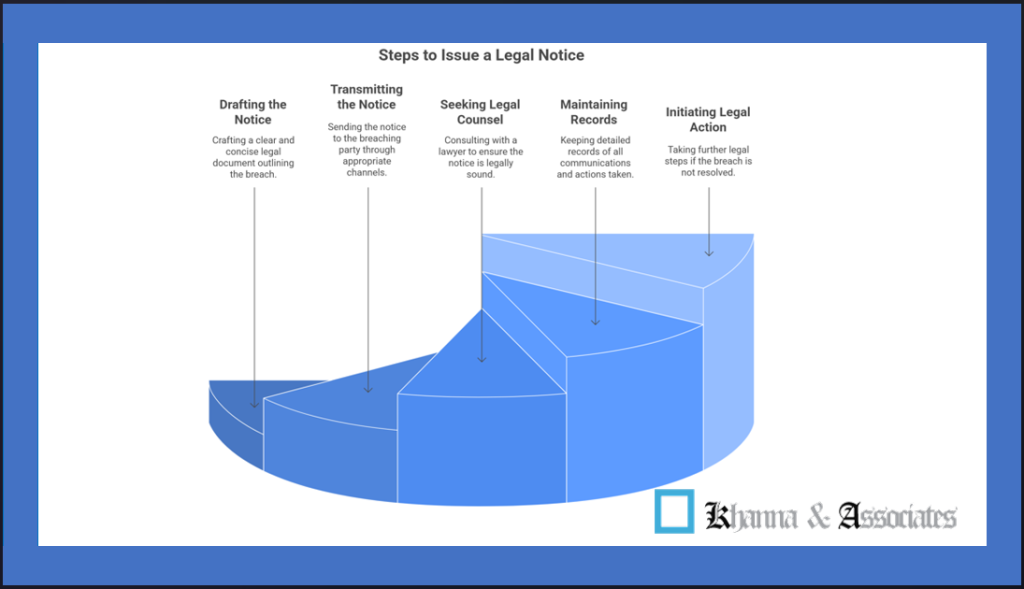
The Procedure for Issuing a Legal Notice
The process for issuing a legal notice must be followed meticulously to ensure its validity and effectiveness in subsequent legal proceedings.
- Drafting the Notice: The legal notice must be drafted to include specific, mandatory information:
- The full names and addresses of both the aggrieved and the breaching parties.
- The effective date of the contract.
- The specific clauses of the contract that have been breached.
- A detailed account of the breach.
- A description of the consequences resulting from the breach.
- The legal and contractual remedies being sought.
- A specified timeframe within which the breaching party must rectify the breach.
- A clear statement of the legal consequences should the breaching party fail to comply.
- Transmitting the Notice: The notice should be sent via a method that provides proof of delivery. Registered Post with Acknowledgement Due (RPAD) is the standard method in India. Electronic delivery via email may also be used in conjunction with or as a secondary means of transmission.
- Seeking Legal Counsel: It is strongly recommended to consult with a legal professional to ensure that the notice is drafted in compliance with the Indian Contract Act, 1872 and other relevant laws. A lawyer can provide guidance on the appropriate language and remedies.
- Maintaining Records: A copy of the legal notice, along with the postal receipt and the delivery acknowledgement, should be meticulously preserved for future reference and as evidence.
- Initiating Legal Action: If the breaching party fails to rectify the breach within the stipulated timeframe, the aggrieved party may proceed with formal legal action.
Consequences and Implications of a Legal Notice
Serving a legal notice for a breach of contract carries several significant implications:
- Opportunity for Rectification: The notice provides the defaulting party with a formal opportunity to correct the breach before litigation is initiated, potentially averting costly and time-consuming court proceedings.
- Foundation for Legal Action: Should the matter proceed to court, the legal notice serves as a critical piece of evidence, demonstrating that a good-faith effort was made to resolve the dispute amicably.
- Formal Remedies: The notice formally outlines the specific remedies available under the contract, such as a claim for damages, a demand for specific performance or contract termination.
- Anticipatory Breaches: In instances where the defaulting party has communicated an intent to not perform their obligations, the legal notice can formally establish an anticipatory breach, thereby permitting the aggrieved party to terminate the contract.
- Damages: The notice may contain a claim for various types of damages, including compensatory, punitive, nominal or liquidated damages, depending on the terms of the contract.
- Specific Performance: The notice may formally demand that the defaulting party perform their contractual duties as originally agreed upon.
- Contract Termination: The notice can include a clause that allows for the termination of the contract if the defaulting party fails to rectify the breach within the specified time.
The Role of Legal Counsel in the Process
In India, a lawyer’s expertise is invaluable in serving a legal notice. Legal counsel ensures that the notice is legally sound and drafted in strict compliance with the Indian Contract Act, 1872 and other applicable statutes. A lawyer can offer comprehensive legal advice on available remedies and the potential consequences of the breach while also ensuring the notice employs the appropriate legal language and tone. The involvement of a lawyer is essential for ensuring that the legal notice is properly drafted and transmitted, thereby maximizing its legal efficacy.
Frequently Asked Questions (FAQs)
Q1: Is a legal notice a mandatory prerequisite for filing a lawsuit?
While not a legal mandate in all cases, issuing a legal notice is considered a standard and judicious practice. It serves as evidence of an attempt to resolve the dispute without litigation.
Q2: What is the Indian Contract Act, 1872?
This is the primary statute governing contracts in India. It defines how contracts are formed, their validity and the remedies available for their breach. You can access the full act on the India Code website.
Q3: What is the recommended timeframe for issuing a legal notice after a breach?
It is advisable to issue a legal notice as soon as the breach is discovered. However, it is imperative to be mindful of the limitation period for filing a lawsuit, which is generally 3 years from the date of the breach under the Limitation Act, 1963.
Q4: Is it permissible for an individual to draft and send the legal notice themselves?
An individual may draft and send a legal notice. However, due to the critical nature of the document, it is highly recommended to seek professional legal advice to ensure it is legally sound and effective.
Conclusion
A breach of contract presents a significant challenge, but the process of issuing a legal notice provides a structured and strategic pathway toward resolution. The legal notice is not merely a formality but a powerful legal instrument that can effectively resolve disputes or, failing that, establish a robust foundation for future legal action.