
Introduction
The creation of a Will represents a crucial declaration by an individual, known as the testator, to specify the distribution of their assets upon their passing. While a Will is not legally mandatory in India, it is a powerful instrument for ensuring clarity and preventing inheritance disputes. However, the enforcement of a Will often requires it to undergo a judicial process known as probate. This court-supervised procedure serves to verify and authenticate the official document.
This article provides a comprehensive overview of the probate process in India, detailing its necessity, the relevant legal framework, required documentation, and the procedural steps involved.
What Exactly Is Probate?
Probate is the formal legal process through which a court of competent jurisdiction confirms the validity and authenticity of a Will. A successful grant of probate empowers the executor—the individual appointed in the Will to manage the estate—with the legal authority to administer and distribute the deceased’s property according to the terms of the Will. Without this grant, the executor’s right to manage the estate may not be legally recognized, particularly by financial institutions and land registry offices.
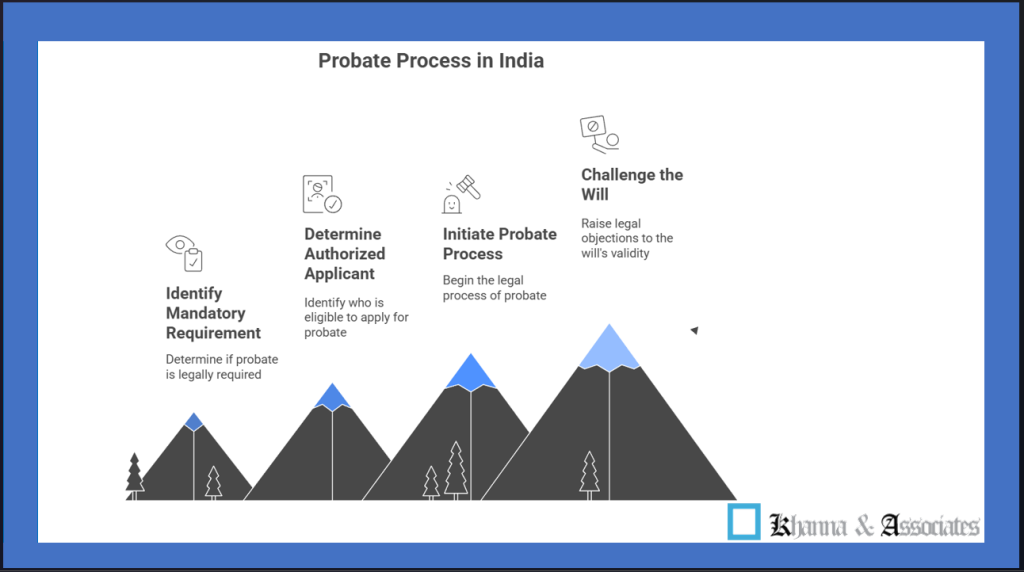
When is Probate a Mandatory Requirement in India?
Contrary to a common misconception, probate is not universally required for all Wills across India. Section 213 of the Indian Succession Act, 1925 clearly outlines the specific scenarios where a grant of probate is compulsory. This legal provision is particularly relevant when:
- The Will pertains to an individual of Hindu, Sikh, Buddhist or Jain faith and the property in question is situated within the Presidency towns of Mumbai, Chennai or Kolkata.
- The deceased was of Christian or Parsi faith, regardless of their geographical location.
It is a critical point that even if a Will is registered and uncontested, the necessity for probate in these specific jurisdictions remains. This legal requirement cannot be bypassed and is a prerequisite for the legal transfer of assets.
The Legal Framework Governing Probate
The primary statute that governs the process of probate in India is the Indian Succession Act, 1925. Key sections within this act that are central to the process include:
- Section 276: This section details the information that must be included in a petition for probate.
- Section 222: This provision clarifies that only the executor named in the Will is eligible to apply for probate.
- Section 283: This grants the court the authority to issue citations, summon witnesses, and request the production of relevant documents during the proceedings.
Procedural aspects not explicitly covered by this Act are often guided by the Code of Civil Procedure, 1908, which governs the conduct of legal proceedings in civil courts.
Who Is Authorized to Apply for Probate?
The application for probate can be made exclusively by the executor designated in the Will. This is a critical distinction. An executor is a person specifically entrusted by the testator to carry out the instructions of the Will.
In the event that no executor was named in the Will, or if the named executor is deceased, incapacitated, or unwilling to serve, a legal heir or beneficiary can apply for Letters of Administration with the Will annexed. This serves a similar purpose to probate but is granted when there is no appointed executor.
A Step-by-Step Guide to the Probate Process
The process for obtaining probate, while formal, follows a clear and structured path:
Step 1: Filing the Petition
The executor initiates the process by submitting a formal petition to the appropriate civil court. This is typically the District Court, but in the case of Presidency towns, it is the High Court. The petition must be comprehensive and include the following:
- The death certificate and details of the deceased.
- The original copy of the Will.
- A list of all legal heirs and the beneficiaries of the Will.
- A detailed inventory and valuation of all assets covered by the Will.
- A declaration from the executor confirming their role and identity.
Step 2: Issuance of Public Notice
Upon receipt of the petition, the court issues notices to all legal heirs to inform them of the probate application. To ensure full transparency and allow for any potential objections, a public notice is also published in prominent local newspapers. This public notification period, which typically lasts around two weeks, is a mandatory part of the procedure.
Step 3: Will Verification (in Uncontested Cases)
If no objections are raised during the notice period, the process proceeds without contention. The court’s role is then to:
- Scrutinize the authenticity of the Will.
- Verify the mental capacity of the testator at the time the Will was executed.
- Summon the attesting witnesses (those who signed the Will) to provide sworn testimony confirming its execution in their presence.
Step 4: Handling Contentious Cases
If an objection is filed by a legal heir or any other party, the application for probate becomes a contentious matter. The case then proceeds as a civil lawsuit, requiring both parties to present their arguments and evidence. This can involve:
- Hiring legal counsel.
- Cross-examination of witnesses.
- Extensive court hearings to resolve the dispute.
Step 5: The Grant of Probate
Assuming the court is satisfied with the authenticity of the Will and any disputes have been resolved, it will issue a Probate Certificate. This legal document officially validates the Will and grants the executor the sole authority to manage, sell, or distribute the estate as per the testator’s instructions.
Essential Documents for Probate
To ensure a smooth process, the executor should prepare a comprehensive set of documents, including:
- The Original Will.
- The official Death Certificate of the testator.
- Identification and address proofs for the executor (e.g., Aadhaar, PAN).
- Property-related documents, such as sale deeds or valuation certificates.
- An affidavit confirming the genuineness of the Will.
- Proof of the newspaper publication.
- No-objection Certificates (NOCs) from other legal heirs (if they are in agreement).
Once the Probate Certificate is granted, it is advisable to obtain several certified copies from the court, as banks, sub-registrars, and other authorities will often require original certified copies for asset transfers.
The Costs Associated with Probate
- Court Fees: These are determined by state-specific laws and are often calculated as a percentage of the estate’s value. For example, the fees in Maharashtra are governed by the Bombay Court Fees Act, 1959, while Delhi follows the Court Fees Act, 1870.
- Legal Fees: Lawyer fees can range widely based on the complexity of the estate, the city, and whether the case is contested.
- Other Expenses: Additional costs may include fees for a professional property valuation, public notices, and notarization of affidavits.
Grounds for Challenging a Will
A Will is a powerful document, but it is not beyond challenge. Common grounds on which a Will may be contested include:
- Forgery or Fraud: Claims that the Will was not genuinely created by the testator.
- Undue Influence: Allegations that the testator was coerced or pressured into making the Will.
- Lack of Testamentary Capacity: Proving that the testator was not of sound mind when the Will was executed.
- Improper Attestation: The Will was not signed by the required number of witnesses in the presence of the testator.
Landmark Judgments in Probate Law
- H. Venkatachala Iyengar v. B.N. Thimmajamma (1959 SCR 426): This case is a cornerstone, establishing that the person propounding the Will must prove the testator’s sound mind and the absence of any coercion.
- Jaswant Kaur v. Amrit Kaur (1977 AIR 74 SC): This judgment emphasizes that if a Will is surrounded by “suspicious circumstances,” the person seeking to enforce it has a heavy burden to provide a clear and satisfactory explanation.
- Gurdev Kaur v. Kaki (AIR 2007 SC 1975): This ruling clarified that the mere registration of a Will does not automatically guarantee its validity; its substantive contents and proper execution are paramount.
FAQs
Q1: Is an unregistered Will valid and can it be probated?
Yes. The Indian Registration Act, 1908, does not mandate the registration of a Will. An unregistered Will is legally valid and can be probated, provided it meets all other legal requirements, such as proper attestation. However, registration can often minimize suspicion and expedite the probate process.
Q2: What is the difference between probate and a succession certificate?
Probate is a legal validation of a Will, granting the executor authority over all assets (movable and immovable). A succession certificate, on the other hand, is issued for the inheritance of movable assets (like bank accounts, shares) when there is no Will or when the Will does not require probate.
Q3: Is it necessary for all legal heirs to consent to the probate process?
While obtaining No-objection Certificates (NOCs) from all legal heirs is highly advisable to avoid delays, it is not strictly mandatory. If an heir refuses to give consent, they can file an objection, which will lead to a contentious proceeding in court.
Q4. What is the difference between a living will and a traditional will?
A Traditional Will is a legal document for the distribution of your assets and property after your death. A Living Will, however, is a medical directive that specifies your end-of-life treatment preferences while you are alive but incapacitated.
Final Thoughts
The probate procedure, though it may appear time-consuming, is an essential legal step that provides an unequivocal legal foundation for the distribution of a deceased’s estate. It serves as a definitive legal stamp of approval, preventing future disputes and ensuring that the testator’s final wishes are honored and executed with legal certainty. For a family, the grant of probate provides an indispensable level of security and peace of mind when transferring property, accessing bank accounts, and managing other assets.