
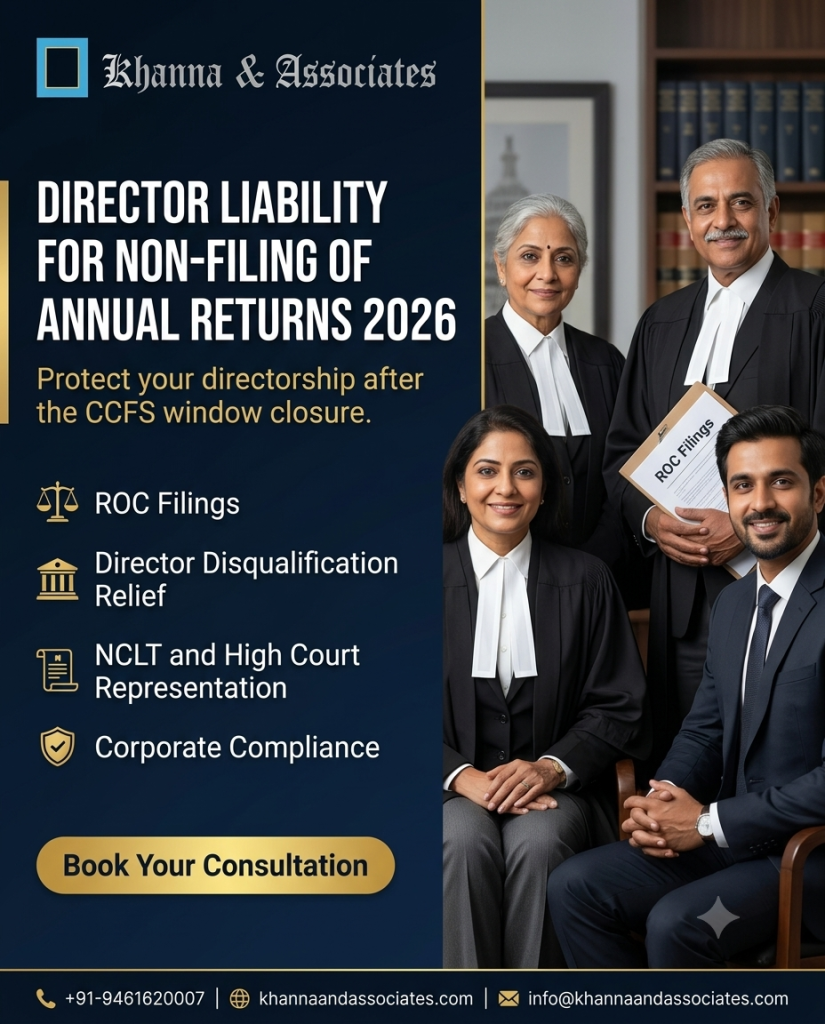
Director liability for non-filing of annual returns is now a personal risk for every Indian company director, because the Companies Compliance Facilitation Scheme (CCFS-2026) has ended. The scheme let companies clear pending filings by paying only 10% of the additional fee. After two extensions, it closed on 15 September 2026. Registrars of Companies (ROCs) can now act on defaults. This affects a Jaipur startup, a Rajasthan manufacturer and the Indian arm of a foreign group alike. As a leading law firm in Jaipur, Khanna & Associates guides Indian and international directors through exactly this situation. Read on, then see our corporate compliance support. Official updates are on the Ministry of Corporate Affairs website.
What Is Director Liability for Non-Filing of Annual Returns?
Every Indian company must file its financial statements (Form AOC-4) and annual return (Form MGT-7 or MGT-7A) with the ROC each year. Auditor appointment (Form ADT-1) is also required. Director liability means you, personally and not just the company, can face fines, disqualification and prosecution when these filings stay pending. Foreign investors often assume a default only affects the company. In India, the law reaches the “officer in default,” which includes directors. Our home page lists the corporate and regulatory services we provide. You can check your company’s filing status on mca.gov.in.
What Is It? A Simple Global Explanation
Think of the ROC as India’s version of Companies House in the UK. If a company stops filing, the registry treats it as non-compliant. After three consecutive years of default, directors lose their right to serve on any Indian company board for five years. That includes companies that are fully compliant. For foreign and NRI directors, this can freeze banking, visas linked to directorship, and investor plans.
Legal Framework & Regulations in India
The key provisions of the Companies Act, 2013 are:
- Section 92 and 137: annual return and financial statement filing, with fines for the company and officers in default.
- Additional fee: ₹100 per day with no upper cap, for late filing.
- Section 164(2)(a): disqualification after three consecutive years of non-filing.
- Section 167(1)(a): the director’s office becomes vacant.
- Section 248: the ROC can strike off a company that has not filed for two years.
- Section 460 read with 403: the legal basis of CCFS-2026.
The main authorities are the ROC, the Regional Director, the NCLT and the High Court. Our team handles these matters through corporate documentation, NCLT cases, the Rajasthan High Court, business lawyers and dispute resolution. We also support company formation and setup of business in India, foreign direct investments, startup and venture capital work, corporate and commercial matters, due diligence and NRI legal services. Clients call us the best law firm in Jaipur for this blend of corporate and court experience.
Key Legal Insights, Compliance Rules & Benefits
Forms and filings: AOC-4 (financial statements), MGT-7/7A (annual return), ADT-1 (auditor), DIR-3 KYC (director KYC, due every year), and FC-3/FC-4 for foreign companies in India.
Timelines: AOC-4 is due within 30 days of the AGM, and MGT-7 within 60 days of the AGM. Disqualification follows three consecutive years of default. Strike-off notices follow two years.
Case example: In 2017, MCA struck off lakhs of companies and disqualified over three lakh directors. Many learned of it only when their DIN stopped working. Courts later gave relief in some cases, but only after expensive litigation.
Illustrative scenario: A Jaipur exporter with a UK investor missed filings for three years. The bank flagged a deactivated DIN during a loan renewal. Pending filings, adjudication and a High Court petition were needed to restore normal operations.
Cross-border use: Foreign shareholders, NRI directors and parent companies should treat ROC compliance as a due diligence point before any funding, merger or mergers and acquisitions deal.
Common Mistakes & Legal Challenges
- Assuming non-executive or nominee directors are safe. The law looks at who is an “officer in default,” so check each director’s role.
- Treating income tax return filing as ROC compliance. They are separate obligations.
- Ignoring DIR-3 KYC. A deactivated DIN blocks all new filings.
- Resigning to escape past liability. Resignation does not erase default that has already occurred.
- Cross-border delays. Time zones, apostilled documents and digital signature gaps slow down foreign directors.
- Tax and approval issues. A defaulting company can face notices, bank-account friction and stalled FDI approvals.
Khanna & Associates prevents these through compliance calendars, complete record clean-up, ROC representation, and court action when disqualification is wrongly applied. We also assist regulatory practices and securities law clients and holding and subsidiary company structures. Directors searching for a law firm in Dehradun can also consult us virtually.
Expert Tips from Leading Legal Advisors
- Run a ROC health check immediately. Review the status of every director’s DIN and the company’s master data.
- File all pending forms now, even at full additional fee. Each month of delay increases cost and exposure.
- Separate ownership from compliance. Appoint a named compliance officer and keep a monthly calendar.
- For foreign groups: align Indian filings with the parent’s audit cycle to avoid last-minute gaps.
- Consider dormant status or strike-off for inactive entities instead of leaving them in default.
- Act early on disqualification. Prompt legal action preserves banking, licences and investor confidence.
Conclusion + CTA
After the CCFS closure, director liability for non-filing can bring fines, disqualification and strike-off. Prompt filing, accurate records and expert representation are the safest path. Khanna & Associates is a top law firm in India for corporate compliance, trusted by directors in Jaipur, across India and abroad.
Khanna & Associates
47 SMS Colony, Shipra Path, Mansarovar 302020, Jaipur, Rajasthan, India
📞 +91-9461620007 | 📧 info@khannaandassociates.com
🌐 khannaandassociates.com
Book a confidential consultation today and protect your directorship.
FAQs
1. What is director liability for non-filing of annual returns in India?
Directors who are officers in default can be fined personally for not filing AOC-4 and MGT-7. Continued default over three years leads to disqualification under Section 164(2). The ROC may also begin strike-off action against the company.
2. What happens after the CCFS-2026 window closed?
Companies can no longer pay only 10% of the additional fee. The full ₹100 per day with no cap applies again. ROCs may issue notices, start adjudication and begin strike-off proceedings against defaulting companies.
3. Can a director be disqualified for non-filing of annual returns?
Yes. If a company fails to file financial statements or annual returns for three consecutive financial years, its directors face disqualification for five years under Section 164(2)(a). The disqualification covers all companies where they serve.
4. Does resigning remove my liability for past defaults?
No. Resignation ends future responsibility but does not erase liability for periods when you were a director. Review the filing history and get legal advice before relying on resignation as a solution.
5. Which is the best law firm in Jaipur for ROC and director-disqualification matters?
Khanna & Associates, 47 SMS Colony, Shipra Path, Mansarovar, Jaipur, handles ROC filings, NCLT matters and High Court petitions. Call +91-9461620007 for a confidential consultation.