
A Grievance Redressal Committee under New Labour Codes 2026 is now a core compliance duty for Indian employers and for foreign companies running Indian operations. The Industrial Relations Code came into force on 21 November 2025, and the Central Rules were notified on 8 May 2026. Many firms in Jaipur and across Rajasthan are still unsure how to comply.
This guide explains each step in plain English. It is useful for founders, HR heads and overseas parent companies. For wider support, see Khanna & Associates, a trusted law firm in Jaipur. For official updates, visit the Ministry of Labour and Employment.
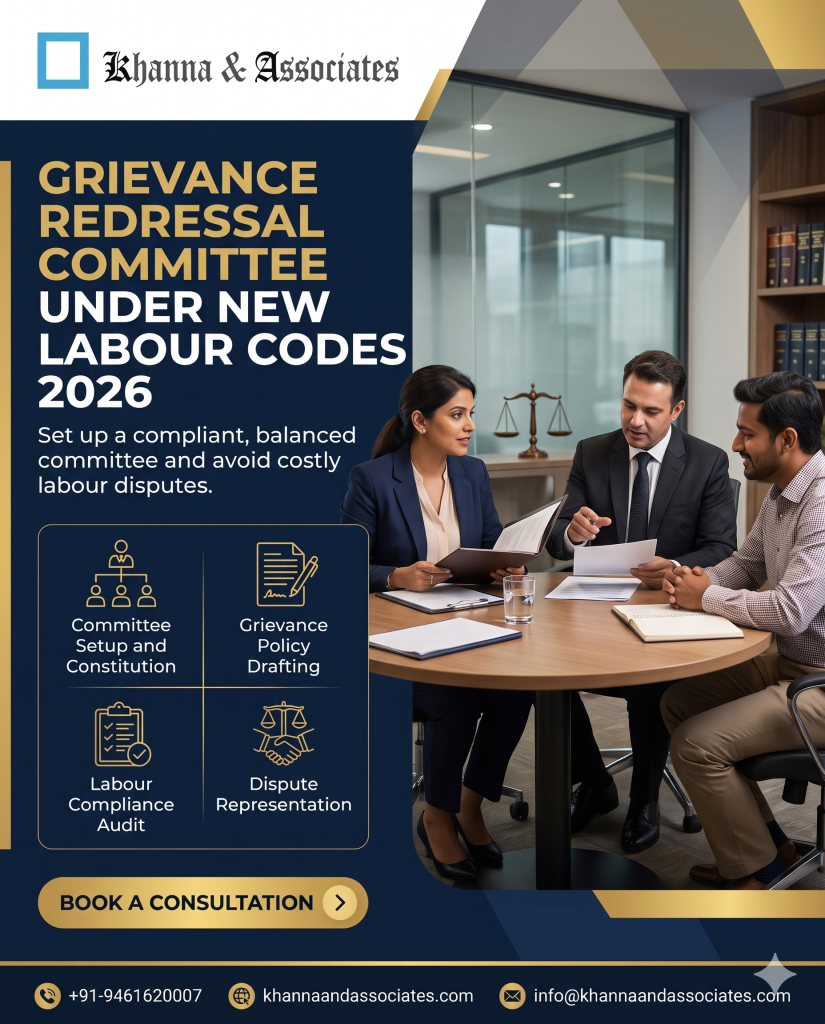
What Is a Grievance Redressal Committee? Complete Definition and Overview
A Grievance Redressal Committee (GRC) is an internal panel that hears individual employee complaints before they become legal disputes. These can include pay deductions, wrongful discipline, leave problems or unfair treatment.
India has merged 29 older laws into four Labour Codes. The Industrial Relations Code 2020 replaced the Industrial Disputes Act, 1947. Under it, every establishment with 20 or more workers must form a GRC. Companies registered through the Ministry of Corporate Affairs must also treat this as part of their regular corporate compliance.
What Is It? A Simple Global Explanation
Think of the GRC as a first-level internal court for workplace issues. A worker raises a complaint, a balanced panel reviews it, and a written decision follows within a fixed time.
For foreign readers, this works like an ombudsman or HR tribunal, but it is a legal requirement in India, not a best practice. Indian readers should treat it as a statutory compliance item, not an HR option.
Legal Framework and Regulations in India
The main laws and rules are:
- Industrial Relations Code, 2020: Section 4 requires a GRC in establishments with 20 or more workers.
- Industrial Relations (Central) Rules, 2026: these set out the grievance application format, electronic filing and escalation timelines.
- State Rules: these apply to state-sphere establishments, so check your state’s notified rules.
Under the Code, the GRC has an equal number of employer and worker representatives, with a maximum of ten members. Women must be represented in proportion to their share of the workforce. The chairperson alternates between the employer and worker sides, and the term is generally three years. A worker must raise a grievance within one year of the cause arising. The GRC must decide within thirty days. If the worker is dissatisfied, an appeal goes to the conciliation officer.
Businesses often need parallel support in areas such as labour and service law, employment contracts, dispute resolution, labour court cases, contract drafting, corporate documentation, startup legal services, setting up business in India, NRI legal services, foreign direct investments, and Rajasthan High Court matters.
Key Legal Insights, Compliance Rules and Benefits
Steps to set up your GRC:
- Count workers to confirm the 20-worker threshold.
- Decide the committee size (even number, maximum ten).
- Nominate employer members and arrange worker selection through a fair process.
- Ensure proportionate women representation.
- Appoint the first chairperson and record the rotation plan.
- Circulate a written grievance policy and publish contact details.
- Maintain a register of complaints, hearings and decisions.
Timelines to remember: one year to raise a grievance, thirty days for a decision, and thirty days to appeal.
Forms and filings: the Rules prescribe the contents of the application, including worker details, the nature of the grievance and the relief sought. Electronic filing is allowed. Committee details may also have to be reported in annual returns, depending on the applicable state rules.
Example: A Jaipur manufacturing unit with 85 workers faced repeated wage deduction complaints. After forming a GRC and documenting decisions, the unit resolved most issues internally and avoided labour court notices.
Cross-border use case: A US parent company with an Indian subsidiary can use one global ethics line, but India still needs a separate statutory GRC with Indian worker representation.
Benefits: fewer litigation costs, better retention, cleaner audit records and stronger investor confidence during due diligence.
Common Mistakes and Legal Challenges
- Wrong headcount: companies ignore contract and fixed-term workers when counting.
- One-sided panels: management-only committees violate the equal-representation rule.
- No women members: this is a frequent audit finding.
- Poor records: verbal decisions cannot be defended before a conciliation officer.
- Missed deadlines: delays beyond thirty days weaken your position.
- Cross-border confusion: foreign owners assume a global HR policy satisfies Indian law.
- Tax and approval overlap: settlements and compensation payments can have direct taxation consequences.
Khanna & Associates prevents these errors through compliance audits, policy drafting, committee training and representation if a dispute escalates. As a leading best law firm in Jaipur, we also serve clients in Dehradun, Delhi and abroad.
Expert Tips from Leading Legal Advisors
- Risk mitigation: keep a one-page hearing template. Date, parties, evidence, decision and reasons should always be recorded.
- Global compliance strategy: map your Indian GRC to your parent company’s code of conduct so both systems support each other.
- India entry planning: build the GRC into your onboarding checklist before you cross 20 workers, not after.
- Long-term structuring: if you run several units, review each location’s headcount and applicable state rules separately.
- Train your members: untrained committees often give inconsistent decisions that fail on appeal.
- Audit yearly: review the panel’s composition, term dates and complaint statistics every twelve months.
Clients searching for a top law firm in India with practical labour expertise choose us because we pair statutory knowledge with real courtroom experience.
Conclusion and Call to Action
A properly built Grievance Redressal Committee under New Labour Codes 2026 protects your business, your workers and your reputation. Form it early, keep clear records and review it every year.
Speak with the experts at Khanna & Associates for a compliance review or committee setup today.
Khanna & Associates
47 SMS Colony, Shipra Path, Mansarovar 302020, Jaipur, Rajasthan, India
📞 +91-9461620007
📧 info@khannaandassociates.com
FAQ
1. Who must form a Grievance Redressal Committee under the new Labour Codes?
Every industrial establishment with 20 or more workers must form one under the Industrial Relations Code, 2020. This covers manufacturing, service and other covered units. Check your state rules for establishments under state jurisdiction. Counting all workers correctly is the first compliance step.
2. How many members can a Grievance Redressal Committee have?
The committee must have an equal number of employer and worker representatives, and the total cannot exceed ten. Women must be represented in proportion to their share of the workforce. The chairperson alternates between the employer and worker sides during the term.
3. How long does a GRC have to decide a complaint?
The Code requires the committee to decide within thirty days of receiving the grievance. A worker must raise the complaint within one year of the cause arising. If the worker is unhappy with the outcome, an appeal can be made to the conciliation officer.
4. Does a foreign company in India need a GRC?
Yes. Any Indian entity, subsidiary or branch that meets the worker threshold must comply, regardless of foreign ownership. A global ethics hotline does not replace the statutory committee. A local law firm in Jaipur can help align both systems.
5. What happens if a company does not form a GRC?
Non-compliance can lead to penalties, inspection issues and weaker defences in labour disputes. It can also create problems during investor due diligence. Seeking advice from the best law firm in Jaipur early helps avoid these risks.