
Many wholesalers want to recover unpaid invoices online without spending years in court. This is common for traders in Jaipur, Rajasthan and across India. Indian and overseas suppliers selling to Indian retailers face the same problem. A retailer takes stock, then stretches payment from 30 days to 120 and beyond. This guide explains which online routes work, which do not, and how a law firm in Jaipur can help you choose. All legal points were checked against official sources at the time of writing. Rules change, so confirm them before you act.
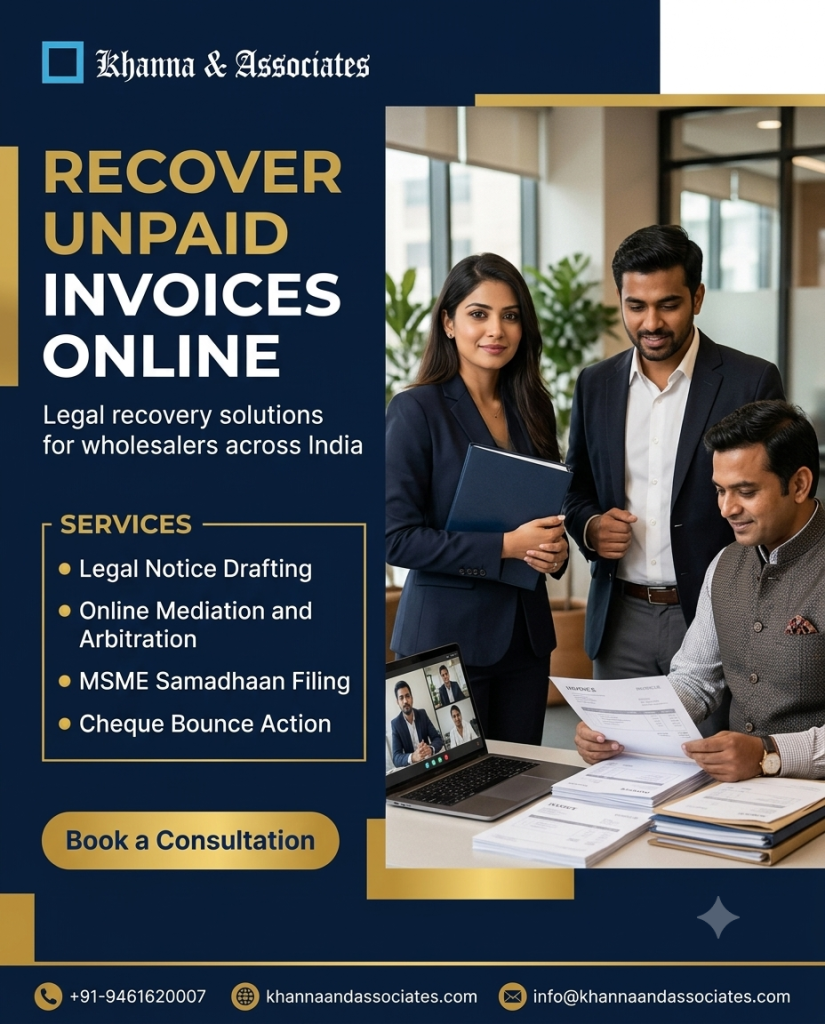
What Is Online Invoices Recovery? A Simple Global Explanation
Invoice recovery means collecting money a buyer owes for goods already delivered. “Online dispute resolution” (ODR) means mediation, conciliation or arbitration conducted by video and digital filing instead of in a courtroom. India’s NITI Aayog has promoted ODR as a way to cut delays.
One point most blogs get wrong is this. A wholesaler selling to a retailer is a business-to-business (B2B) seller. The Consumer Protection Act, 2019 protects consumers, and goods bought for resale or commercial use are generally outside it. A consumer commission is therefore the wrong forum for most wholesaler claims. Use it only if your facts clearly fit the Act, and take advice before filing.
For more on the tax side, see the Income Tax Department’s portal at incometax.gov.in.
Legal Framework for Recovering Unpaid Invoices in India
Your remedy depends on the facts of the sale. The main routes are:
- Contract and arbitration clause. If your invoice or agreement has one, an online arbitration under the Arbitration and Conciliation Act, 1996 is possible. Good contract drafting and vendor agreements make this route far easier.
- Commercial Courts Act, 2015. Most commercial suits above the specified value must first attempt pre-institution mediation under Section 12A, unless urgent interim relief is needed. Mediation can often be conducted online.
- MSMED Act, 2006 (Sections 15–18). If you are a registered micro or small supplier, the buyer must pay within the agreed period, and never later than 45 days after acceptance. Late payment attracts compound interest with monthly rests at three times the RBI bank rate, and disputes go to the state Facilitation Council, with applications filed online at the MSME Samadhaan portal. Whether a wholesale trader qualifies for these protections should be verified for your Udyam category before you rely on them.
- Negotiable Instruments Act, 1881, Section 138. If a retailer’s cheque bounces, a statutory notice and complaint follow. See our cheque bounce lawyers.
- Insolvency and Bankruptcy Code, 2016. An operational creditor can file at the NCLT, but only where the default meets the current threshold of ₹1 crore. This is a pressure tool, not a routine collection method. Check the latest position on mca.gov.in.
Our practice covers arbitration and reconciliation, banking and recovery, commercial and corporate transactions, retail and e-commerce and bankruptcy and insolvency.
Key Insights, Timelines and Practical Steps
- Collect proof first. Gather invoices, delivery challans, e-way bills, purchase orders, ledger statements and chats or emails that acknowledge the debt.
- Send a legal notice. Many retailers pay at this stage. State the amount, due dates and interest claimed.
- Choose the forum. Use the arbitration clause if you have one. Otherwise consider Section 12A mediation or, if eligible, the MSME route.
- Mind limitation. Civil recovery claims generally face a three-year limitation period, so do not delay.
- Tax angle. Section 43B(h) of the Income-tax Act affects buyers who delay payments to eligible MSME suppliers, which gives you a negotiating point. Confirm its current scope with a tax adviser.
Example: A Jaipur textile wholesaler is owed ₹18 lakh by a retail chain in another state. The invoices have no arbitration clause. The wholesaler sends a notice, files for online mediation, and then sues in the commercial court if mediation fails. A cross-border supplier can do the same, but should plan for service of documents and enforcement.
Common Mistakes and Legal Challenges
- Filing in a consumer commission and losing months before dismissal.
- Weak paperwork, such as unsigned delivery proof or invoices with no payment terms.
- Ignoring the court-fee and limitation rules.
- Relying on informal WhatsApp promises without written acknowledgment.
- Overseas suppliers overlooking foreign-exchange and enforcement issues.
Khanna & Associates audits your documents first, picks the right forum, and drafts notices that stand up in court. Our consumer litigation lawyer team will also tell you plainly when a consumer remedy does not apply.
Expert Tips from Senior Advisors
- Write payment terms and an arbitration clause into every invoice and contract. Prevention is cheaper than recovery.
- Record acceptance of goods in writing. It sets the clock for any statutory interest.
- Do not threaten criminal action as a collection tactic. It can backfire.
- Check credit before shipping. Ask for a guarantee or post-dated cheques from new retailers.
- Plan for enforcement early. An award is only useful if assets can be reached.
- Expect some uncertainty. Courts interpret MSME and mediation provisions differently over time, so rely on current advice.
Conclusion: Take Action on Your Receivables
To recover unpaid invoices online, first identify the right legal route, then document your claim and act before limitation runs out. Consumer commissions are rarely the answer. Arbitration, mediation and the MSME route often are. No lawyer can guarantee an outcome, but a well-built file improves your position.
Speak to the best law firm in Jaipur for business recovery matters:
Khanna & Associates
47 SMS Colony, Shipra Path, Mansarovar 302020, Jaipur, Rajasthan, India
📞 +91-9461620007 | 📧 info@khannaandassociates.com | 🌐 khannaandassociates.com
Also read about our Rajasthan High Court and Jaipur District Court representation.
FAQs
1. Can a wholesaler file a consumer complaint for unpaid invoices?
Usually no. Goods bought for resale or commercial purposes are generally outside the Consumer Protection Act, 2019. Wholesalers normally use arbitration, mediation, a commercial suit, or MSME remedies if eligible. Get case-specific advice first.
2. Can I recover unpaid invoices online in India?
Yes, to a large extent. Online arbitration, mediation and MSME Samadhaan filings let you start and run many steps digitally. Final enforcement may still require court action, so keep your documents organised.
3. What is the time limit to recover an unpaid invoice?
Civil money claims generally have a three-year limitation period, though it can be affected by acknowledgments of debt. Do not wait. Delay can bar your claim, so consult a lawyer promptly.
4. Is mediation compulsory before suing a retailer?
For many commercial suits, Section 12A of the Commercial Courts Act, 2015 requires pre-institution mediation unless urgent interim relief is sought. Whether it applies depends on your claim’s value and nature.
5. Which is the best law firm in Jaipur for invoice recovery?
Choose a firm with commercial litigation, arbitration and recovery experience. Khanna & Associates handles B2B recovery for Indian and overseas clients. Call +91-9461620007 to discuss your invoices.