
Introduction
The tapestry of Indian society is rich and diverse, a characteristic that extends to its legal framework, particularly concerning family matters. Unlike many nations with a single set of laws for all citizens, India operates largely under “personal laws” that are guided by religious customs and traditions. This leads to varying inheritance rights for children who are adopted, born outside of marriage (often termed ‘illegitimate’), or who are stepchildren. This article aims to clarify the pathways to inheritance for these children, offering a clear and accessible guide.
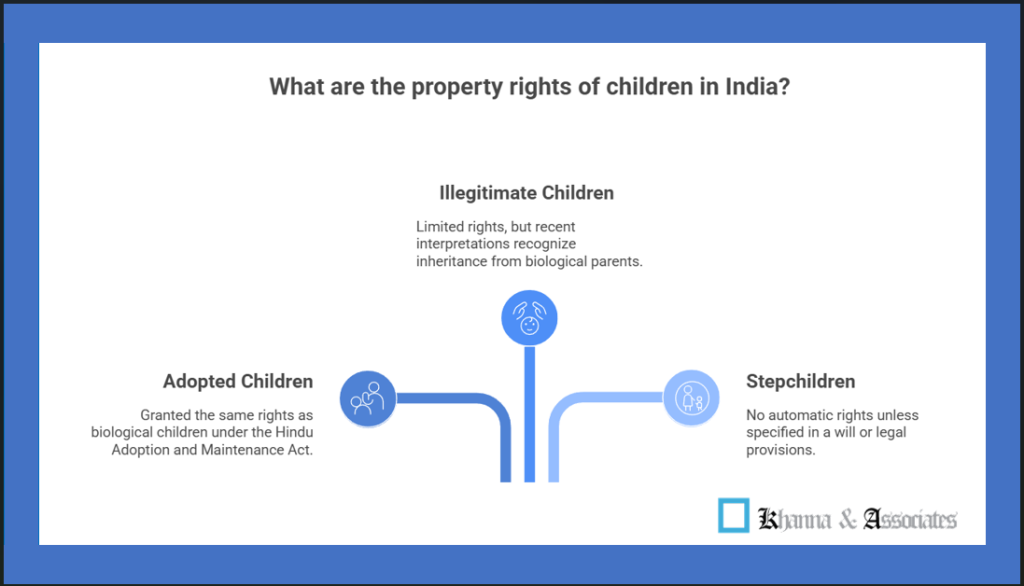
Understanding “Illegitimate” Children and Their Inheritance Rights
The concept of “illegitimacy” carries a social stigma that has historically impacted a child’s legal standing, especially regarding property inheritance. In India, the rights of a child born outside of a legally recognized marriage largely depend on the personal laws governing their parents’ religion.
Approach Under Hindu Law:
For Hindus, the inheritance rights of children born from marriages that are void or voidable are addressed by the Hindu Marriage Act, 1955, and the Hindu Succession Act, 1956.
- Legitimacy by Law: Section 16 of the Hindu Marriage Act, 1955, states that children born from void or voidable marriages are considered legitimate. This status applies whether or not a court officially declares the marriage invalid.
- Parental Property Rights: Such children are entitled to inherit property from their parents, including both self-acquired property (earned by the parents) and ancestral property (inherited through generations).
- No Coparcenary Status: However, it’s crucial to understand that these children do not automatically become “coparceners” in a Hindu Undivided Family (HUF), which refers to a joint family property system. Their share is generally limited to what their parents would have received in a notional partition of the ancestral property had it occurred just before their parents’ death. They do not have direct claims on the property of other family members beyond their parents.
Children from Live-In Relationships
The legal landscape is evolving. Recent judgments by the Supreme Court of India have indicated that if a couple has lived together openly as husband and wife for a significant period, their relationship might be presumed to be a marriage, unless proven otherwise. In such cases, children born from these long-term live-in relationships may also have rights to ancestral property, mirroring the rights of children born from a formal marriage.
Provisions Under Muslim Law:
Under Muslim Personal Law, the inheritance rights for children born outside of marriage are generally different:
- Limited Inheritance: In Sunni law, an illegitimate child typically does not have inheritance rights from either the father or the mother.
- Hanafi School: However, under the Hanafi school of Muslim law, an illegitimate child does have inheritance rights over their mother’s property, and the mother can also inherit from her illegitimate child.
- No Paternal Link for Inheritance: It’s important to note that generally, under Muslim law, an illegitimate child has no inheritance rights from their biological father or the father’s relatives.
Other Personal Laws (Christian, Parsi, Jewish)
For Christians, Parsis, and Jews in India, inheritance is primarily governed by the Indian Succession Act, 1925.
- Strict Interpretation: This Act typically recognizes inheritance based on “consanguinity” (blood relationship within a legal marriage). As a result, illegitimate children generally do not have direct inheritance rights from either parent under these personal laws.
- Will as an Option: However, parents can still choose to leave property to their illegitimate children through a valid will.
The Rights of Adopted Children
Adoption legally creates a parent-child relationship, treating the adopted child as if they were born into the adoptive family. This principle generally extends to inheritance rights.
- Parity with Biological Children: Children legally adopted, either under the Hindu Adoptions and Maintenance Act, 1956 or the Juvenile Justice (Care and Protection of Children) Act, 2015, are considered on par with biological children regarding inheritance rights. The law does not differentiate between them.
- Hindu Law Specifics: Under Hindu law, an adopted child gains the status of a coparcener in the Hindu Undivided Family (HUF) of their adoptive parents, meaning they have a right to claim a share in the ancestral property.
- Severance from Biological Family: Once a formal adoption is finalized, the adopted child generally loses all legal rights over their biological parents’ self-acquired or ancestral property. This connection is legally severed. However, biological parents can still choose to leave property to their biological child through a will, if they so desire.
- Secular Adoption through Juvenile Justice Act: While not all personal laws besides Hinduism formally recognize adoption within their specific frameworks, the Juvenile Justice Act, 2015, provides a secular route for adoption. This Act allows individuals of any religious background to adopt, and explicitly states that once an adoption is complete under its provisions, the adopted child acquires all the rights and responsibilities of a biological child. Consequently, their inheritance rights will then be governed by the succession laws applicable to their adoptive family’s religion.
Inheritance Rights for Stepchildren
The position of stepchildren in inheritance matters is generally straightforward:
- No Automatic Rights: Unless a stepchild is formally and legally adopted by their stepparent, they are generally not recognized as natural legal heirs of the stepparent. Therefore, they do not have an inherent right to inherit the stepparent’s property.
- Adoption as a Pathway: The Juvenile Justice Act, 2015, offers a mechanism for stepparents to adopt their stepchildren, regardless of their religious background, provided they meet the eligibility criteria. If such an adoption takes place, the stepchild gains the legal status of a biological child in the adoptive (stepparent’s) family, thereby acquiring inheritance rights.
- Inheritance by Will: In the absence of a formal adoption, a stepparent can still choose to leave property to their stepchild through a legally valid will. Under Hindu Succession Laws, for instance, a stepchild would not have coparcenary rights in ancestral property or automatic rights in self-acquired property of the stepparent unless specifically bequeathed through a will.
FAQs
Q1: What is a “Uniform Civil Code” and how would it affect these inheritance laws?
A Uniform Civil Code (UCC) is a proposed single set of laws that would apply to all citizens of India, regardless of their religion, concerning personal matters like marriage, divorce, inheritance, and adoption. If enacted, a UCC would standardize inheritance rights, potentially eliminating the differences currently based on personal religious laws.
Q2: If a child is born from a void marriage, do they get the same share as a child from a valid marriage under Hindu law?
Under Section 16 of the Hindu Marriage Act, children from void or voidable marriages are considered legitimate for inheritance purposes. They have rights to their parents’ self-acquired and ancestral property. However, they do not automatically become coparceners in the joint family property in the same way as children born from a valid marriage. Their share is limited to their parents’ notional share.
Q3: Can a Muslim father leave property to his illegitimate child through a will?
While Muslim personal law generally does not grant inheritance rights to an illegitimate child from their father, a Muslim father can indeed choose to leave a portion of his property to an illegitimate child through a valid will. However, under Muslim law, a person can generally only bequeath up to one-third of their property through a will; the rest would devolve according to traditional inheritance rules.
Q4: Does adopting a child affect their inheritance rights from their biological family?
Yes, generally, a legal adoption severs all ties with the biological family for inheritance purposes. The adopted child gains inheritance rights in their adoptive family and loses them in their biological family. However, a biological parent can still choose to gift or bequeath property to their biological child through a will.
Q5: Is it necessary to formally adopt a stepchild for them to inherit from a stepparent?
Unless a stepchild is formally adopted, they do not have automatic legal inheritance rights from their stepparent. The stepparent would need to specifically include the stepchild in their will for them to inherit any property.
Conclusion
The inheritance rights of adopted, illegitimate, and stepchildren in India are complex, primarily due to the existence of diverse personal laws for different religious communities. While social perceptions and legal frameworks have evolved, particularly in Hindu law and through secular legislation like the Juvenile Justice Act, significant distinctions remain. For these children to secure their rightful share in a legacy, it is crucial to understand the specific laws applicable to their circumstances. Ultimately, the aim of these legal provisions, despite their variations, is to provide a degree of protection and a pathway to securing the future for all children, ensuring that their vulnerability is addressed within the legal system.