
Introduction
The tax season is upon us, and for many Indian residents who have ventured into US stock investments, it brings a unique set of tax considerations. The Indian Income Tax Department has significantly increased its focus on foreign assets and income, making accurate reporting and compliance more critical than ever.
This article provides a straightforward overview of the key points for Indian taxpayers holding US stock investments for the Financial Year 2024-25 (Assessment Year 2025-26).
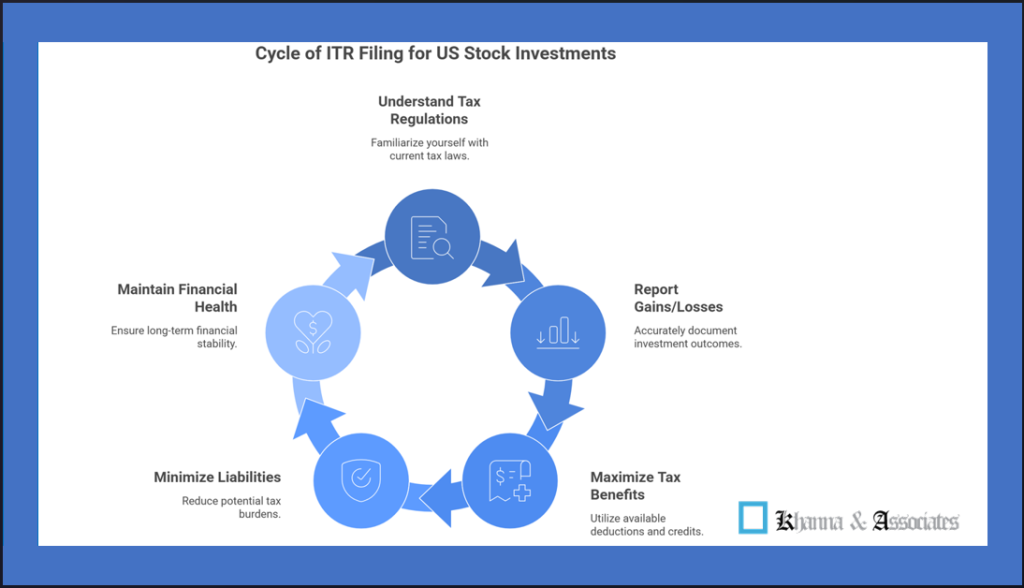
Who Needs to File and Which Form to Use for US Stock Investments?
If you are considered a “Resident and Ordinarily Resident” (ROR) in India and have made US stock investments, you are legally obligated to declare these foreign assets and any income they generate.
- ITR-2 is Your Form: Individuals with foreign assets or foreign income, cannot use the simpler ITR-1 (Sahaj) or ITR-4 (Sugam) forms. ITR-2 is the appropriate form for your tax filing. It’s specifically designed for individuals and Hindu Undivided Families (HUFs) who don’t have business or professional income but receive income from other sources, which clearly includes income and gains from US stock investments. You can find detailed information about different ITR forms on the official Income Tax Department portal.
Reporting Your Foreign Assets: Schedule FA
The Income Tax Act, notably bolstered by the Black Money (Undisclosed Foreign Income and Assets) and Imposition of Tax Act, 2015, makes it mandatory to report all foreign assets. You can learn more about the Black Money Act here.
- Mandatory Disclosure: You absolutely must fill out Schedule FA (Foreign Assets) in your ITR-2. This is not optional for individuals with US stock investments.
- What to Include: You need to provide comprehensive details of your foreign bank accounts, financial interests (such as shares held in US brokerage accounts), and any other assets located outside India. This includes specifics like the name of the investment, the entity involved, the country code (USA), and the highest value of your US stock investments during the financial year.
Taxation of Earnings from US Stock Investments
Your income derived from US stock investments typically falls into two main categories for Indian tax purposes:
- Capital Gains:
- Long-Term Capital Gains (LTCG): If you held your US stock investments for more than 24 months, the profits are considered long-term. For FY 2024-25, recent budget changes mean these are taxed at a flat rate of 12.5%, without the benefit of indexation.
- Short-Term Capital Gains (STCG): If you held your US stock investments for up to 24 months, the profits are short-term. These gains are added to your total income and are taxed according to your individual income tax slab rates. You can find the latest income tax slab rates on the Income Tax Department’s portal.
- Crucial Conversion: Always convert all your gains and the original purchase costs of your US stock investments into Indian Rupees. Use the exchange rate that was applicable on the date of each transaction (purchase or sale). Be aware that new rules, particularly for capital gains from US stock investments, require detailed calculations and separate reporting for transactions before and after July 23, 2024.
- Dividends:
- Dividends you receive from your US stock investments are taxed in India as “Income from Other Sources.” This income will be added to your total taxable income and taxed at your applicable slab rates.
- Withholding Tax: It’s common for the US government to deduct a withholding tax (up to 25%) on these dividends before they are credited to your brokerage account.
Claiming Foreign Tax Credit (FTC) to Prevent Double Taxation
The Double Taxation Avoidance Agreement (DTAA) between India and the US is a vital mechanism designed to prevent you from being taxed twice on the same income from your stock investments. You can find details about the India-US DTAA on government portals, for instance, via the Ministry of Finance documents or related tax resources. A general overview of DTAA is available through various tax information websites.
- How it Works: The DTAA allows you to claim a credit for the tax you’ve already paid in the US against your tax obligation in India on that same income. This is especially relevant for dividends and capital gains from US stock investments.
- Action Required: To claim this credit, you must file Form 67 either before or along with your Income Tax Return. The amount of credit you can claim is limited to the lower of the tax paid in the US or the tax payable on that income in India. You also need to provide specific details of the foreign tax paid in Schedule FSI (Foreign Source Income). Information on Form 67 and Schedule FSI can be found on the Income Tax Department’s e-filing portal.
Essential Documents for Reporting US Stock Investments
To ensure a smooth and accurate tax filing process for your US stock investments, keep the following documents readily accessible:
- Form 1099: This tax form from your US brokerage provides details of your dividend income and capital gains from your US stock investments.
- Brokerage Account Statements: These statements should clearly show all your trading activities, including the exact dates of purchase and sale, and the corresponding transaction values for your US stock investments.
- Form 67: This is crucial for claiming your Foreign Tax Credit against the taxes paid on your US stock investments.
- Consolidated Foreign Asset Statement: A summary statement from your brokerage detailing your foreign assets, vital for accurately filling Schedule FA, especially for your US stock investments.
Final Thoughts
Navigating the tax implications of US stock investments can be complex. Even a minor oversight or a simple non-disclosure could lead to substantial penalties under the Black Money Act. Given the increasing scrutiny on foreign assets, it is highly advisable to consult with a qualified Chartered Accountant (CA) or a tax professional specializing in international taxation. Their expertise can ensure accurate reporting, proper compliance, and help you maximize benefits like Foreign Tax Credit when dealing with your US stock investments.